

Article · part of a guide
Top 10 Most Popular Terraform Modules [2026]
Explore 2026’s 10 most-downloaded Terraform modules, from AWS VPCs to EKS, with links, GitHub stats and quick-start tips for faster IaC builds.
![Top 10 Most Popular Terraform Modules [2026]](/_next/image?url=%2Fimages%2Fblog%2Fterraform-modules-analytics-dashboard-laptop-tablet.webp&w=3840&q=75)
Key takeaways
- The most-downloaded Terraform modules are the official, provider-maintained collections: terraform-aws-modules (VPC, IAM, EKS, S3, Lambda), Azure Verified Modules (AVM), and terraform-google-modules.
- AWS modules dominate by volume. terraform-aws-modules/iam (235M+ all-time downloads) and /vpc (126M+) lead the Terraform Registry.
- Azure is standardizing on curated Azure Verified Modules (AVM); GCP relies on the opinionated terraform-google-modules collection.
- Always pin module versions (e.g. version = "~> 5.0"). Popularity is no substitute for governance.
- At scale, the hard part is using modules consistently: a private registry, version pinning, and policy-as-code matter more than the module list itself.
The most popular Terraform modules in 2026 are the official, provider-maintained collections: terraform-aws-modules (VPC, IAM, EKS, S3, and Lambda), Azure Verified Modules (AVM), and terraform-google-modules. Together they account for the majority of Terraform Registry downloads. Below is the full top 10 ranked by download volume, with usage examples and what it takes to standardize on them across a team.
What teams actually use
Most Terraform infrastructure, from simple S3 buckets to Kubernetes clusters, gets built with modules: reusable, shareable packages of Terraform configurations. So the practical question is which ones teams reach for.
As of 2026, a handful of players and patterns dominate Terraform module usage. The collections that are provider-specific, officially endorsed, or heavily community-backed get most of the downloads. Teams pick them for trust and reliability about as much as for convenience. And the more you use modules, the more work it takes to manage them across an organization. Knowing what's popular tells you where to start, but you still have to make sure modules get used consistently and securely, which is what platforms built for IaC governance handle.
These module collections work the same whether your team runs Terraform or OpenTofu, since both engines resolve the same registry artifacts. If you are weighing the two engines, our OpenTofu vs Terraform comparison breaks down the licensing, governance, and feature differences.
The Big Three Clouds: Module Dominance
Unsurprisingly, the most used Terraform modules are tightly coupled with the major cloud providers: AWS, Azure, and GCP. Each has its own ecosystem and approach.
AWS: The Reign of terraform-aws-modules
For Amazon Web Services, the terraform-aws-modules collection is still the clear leader, and its modules are the de facto standard for provisioning AWS resources.
terraform-aws-iam: With 235.9 million all-time downloads, this module for managing Identity and Access Management is foundational.terraform-aws-vpc: Clocking in at 126.0 million all-time downloads, it’s the go-to for setting up network infrastructure.terraform-aws-s3-bucket: Essential for storage, with 117.8 million all-time downloads.terraform-aws-eks: For Kubernetes on AWS, this module has 96.3 million all-time downloads.terraform-aws-lambda: Powering serverless applications, it has 78.9 million all-time downloads.
They've stayed popular because they're mature and cover a wide range of AWS services in detail.
Azure: The Rise of Azure Verified Modules (AVM)
Microsoft Azure is taking a more curated approach with its Azure Verified Modules (AVM) initiative. Microsoft is pushing AVM as a set of officially supported, high-quality, consistently designed modules that serve as a benchmark for deploying Azure resources with Terraform.
While the underlying azurerm provider is nearing a billion downloads (showing massive Terraform adoption on Azure), AVMs themselves are steadily gaining traction.
Azure/avm-res-compute-virtualmachine/azurerm: A key module for VMs, showing around 20,000 monthly downloads.Azure/avm-res-storage-storageaccount/azurerm: For fundamental storage needs.Azure/avm-res-network-virtualnetwork/azurerm: Core for VNet provisioning.Azure/avm-res-containerservice-managedcluster/azurerm: For Azure Kubernetes Service.
The AVM program, which includes both "Resource Modules" for individual services and "Pattern Modules" for common architectural solutions, shows Microsoft investing in the Terraform experience on Azure. This top-down standardization contrasts with AWS's more organic module ecosystem growth.
GCP: terraform-google-modules and the Power of Opinion
Google Cloud Platform users heavily rely on the terraform-google-modules collection. These modules are often described as "opinionated," meaning they encapsulate Google's recommended best practices.
terraform-google-modules/project-factory/google: Extremely popular for setting up new GCP projects with correct IAM, Shared VPC, and API enablement, it sees around 1.1 million monthly downloads and has 48.5 million all-time.terraform-google-modules/network/google: For VPCs, subnets, and firewall rules, also with about 1.1 million monthly downloads and 36.0 million all-time.terraform-google-modules/kubernetes-engine/google: The standard for deploying GKE clusters, with 39.3 million all-time downloads.
That opinionated design is a big part of the appeal, because it lets teams deploy standardized, well-architected infrastructure quickly.
Popular Module Snippets
Here's a taste of what using these popular modules looks like.
AWS VPC Example
module "vpc" {
  source  = "terraform-aws-modules/vpc/aws"
  version = "~> 5.0" # Always pin your module versions!

  name = "my-app-vpc"
  cidr = "10.0.0.0/16"

  azs             = ["us-east-1a", "us-east-1b", "us-east-1c"]
  private_subnets = ["10.0.1.0/24", "10.0.2.0/24", "10.0.3.0/24"]
  public_subnets  = ["10.0.101.0/24", "10.0.102.0/24", "10.0.103.0/24"]

  enable_nat_gateway = true
  single_nat_gateway = true

  tags = {
    Terraform   = "true"
    Environment = "dev"
  }
}
This snippet shows a basic VPC setup using the widely adopted terraform-aws-modules/vpc/aws module.
Azure Storage Account (AVM) Example
module "storage_account" {
  source  = "Azure/avm-res-storage-storageaccount/azurerm"
  version = "~> 0.6" # Pin AVM versions too

  name                = "myappstgacct${random_string.suffix.result}"
  resource_group_name = "my-app-rg"
  location            = "eastus"
  account_tier        = "Standard"
  account_replication_type = "LRS"

  tags = {
    environment = "production"
    project     = "myapp"
  }
}

resource "random_string" "suffix" {
  length  = 6
  special = false
  upper   = false
}
Here, we're using an Azure Verified Module to create a storage account, benefiting from Microsoft's stamp of quality.
GCP Project Factory Example
module "my_project" {
  source  = "terraform-google-modules/project-factory/google"
  version = "~> 18.0"

  name              = "my-gcp-project-123"
  random_project_id = true
  billing_account   = "YOUR_BILLING_ACCOUNT_ID" # Replace with your actual billing account ID
  folder_id         = "YOUR_FOLDER_ID"          # Optional: Replace with your folder ID

  activate_apis = [
    "compute.googleapis.com",
    "storage.googleapis.com",
    "container.googleapis.com",
  ]

  labels = {
    environment = "staging"
    owner       = "data-platform-team"
  }
}
The project-factory module simplifies creating well-structured GCP projects according to best practices.
The Broader Ecosystem: HashiCorp, Community, and Orchestration
Beyond the cloud provider giants, HashiCorp offers modules for its own tools like Consul and Vault, which have significant historical downloads. The Terraform Registry also hosts nearly 20,000 community modules, catering to a "long tail" of niche tools and specific application stacks.
Tools like Terragrunt are popular for orchestrating multiple modules and environments. As organizations grow, though, they usually need a more centralized, integrated way to manage modules. Platforms with a private module registry, version control, and governance workflows, such as Scalr, help teams discover, share, and manage both public and private modules with more control and visibility. Teams that hit this wall on Terraform Cloud often start comparing alternatives to Terraform Cloud on exactly these registry and governance capabilities.
Why These Modules?
The dominance of officially verified or heavily community-backed modules isn't accidental. It's driven by:
- Trust and Official Support: AVMs,
terraform-aws-modules, andterraform-google-modulescome with a level of assurance regarding quality, maintenance, and alignment with best practices. - Active Maintenance and Community: Strong GitHub activity, frequent updates, and responsive maintainers build confidence.
- Good Documentation and Examples: Clear documentation and practical examples lower the barrier to adoption.
But even with trusted modules, organizations face the challenge of ensuring they are used correctly and adhere to internal policies. Pinning module versions is a basic best practice, but what about enforcing specific configurations or security standards within those modules? Policy-as-code tools answer that by applying organizational guardrails, and they're often built into IaC management platforms like Scalr (e.g., via Open Policy Agent - OPA).
Top Terraform Modules at a Glance (2026)
| Module Name (Abbreviated) | Cloud | Primary Function | Typical Monthly Downloads (Approx. 2026) | All-Time Downloads (Approx. 2026) |
|---|---|---|---|---|
terraform-aws-modules/iam |
AWS | Identity & Access Management | 9.9M | 235.9M |
terraform-aws-modules/vpc |
AWS | Virtual Private Cloud Networking | 4.0M | 126.0M |
terraform-aws-modules/s3-bucket |
AWS | S3 Storage Buckets | 4.9M | 117.8M |
terraform-aws-modules/eks |
AWS | Elastic Kubernetes Service | 3.1M | 96.3M |
Azure/avm-res-compute-vm |
Azure | Virtual Machines | 20.1K | 179.5K |
Azure/avm-ptn-hubnetworking |
Azure | Hub & Spoke Networking | 6.2K | 38.0K |
terraform-google-modules/project-factory |
GCP | Opinionated Project Creation | 1.1M | 48.5M |
terraform-google-modules/network |
GCP | VPC Networking | 1.1M | 36.0M |
terraform-google-modules/kubernetes-engine |
GCP | Google Kubernetes Engine | N/A (High All-Time) | 39.3M |
Note: Monthly downloads can fluctuate. "N/A" indicates specific monthly data wasn't highlighted for that module in the 2026 analysis, but all-time figures confirm high usage.
The Future of Modules: Standardization, AI, and Smarter IaC
A few trends are shaping where the Terraform module ecosystem goes next:
- Increased Standardization: Initiatives like AVM are pushing for more reliable, secure, and well-maintained modules.
- AI-Assisted Usage: HashiCorp's Terraform MCP server and GitHub Copilot integration promise natural language queries for module discovery and configuration.
- Higher Abstraction Levels: "Pattern" or "solution" modules that deploy entire pre-configured environments are gaining traction.
- Security and Compliance Focus: Tools like Checkov and Pike are becoming integral, and modules will increasingly embed security best practices.
More of the IaC work will be managing and governing a large set of code components, on top of writing them. Platforms that provide module management, policy enforcement (like Scalr's OPA and Checkov integration), and clear visibility into IaC operations will matter more as that happens.
From Usage to Effective Management
Once you're past picking modules, the work shifts to managing them. As organizations scale their IaC efforts, discovery, versioning, consistency, and governance across many modules and teams get harder. The job moves from consuming modules to curating, controlling, and automating their use. Dedicated IaC management platforms handle that side, turning a collection of building blocks into a governed, scalable infrastructure setup.
Honorable Mentions: Modules 11-20
Beyond the top 10, these modules are also widely used across the Terraform ecosystem:
11. Google IAM Terraform Module
A Terraform module which makes it easier to non-destructively manage multiple IAM roles for resources on the Google Cloud Platform. You can use this module with a collection of various submodules.
module "projects_iam_bindings" {
  source  = "terraform-google-modules/iam/google//modules/projects_iam"
  version = "~> 6.4"

  projects = ["project-123456", "project-9876543"]

  bindings = {
    "roles/storage.admin" = [
      "group:[email protected]",
      "user:[email protected]",
    ]

    "roles/compute.networkAdmin" = [
      "group:[email protected]",
      "user:[email protected]",
    ]

    "roles/compute.imageUser" = [
      "user:[email protected]",
    ]
  }
}
12. Terraform-google-cloud
This module allows you to execute gcloud commands within Terraform.
module "gcloud" {
  source  = "terraform-google-modules/gcloud/google"
  version = "~> 2.0"

  platform = "linux"
  additional_components = ["kubectl", "beta"]

  create_cmd_entrypoint  = "gcloud"
  create_cmd_body        = "version"
  destroy_cmd_entrypoint = "gcloud"
  destroy_cmd_body       = "version"
}
13. Terraform-yaml-stack-config
A Terraform module which loads an opinionated "stack" configuration from local or remote YAML sources. It supports deep-merged variables, settings, ENV variables, backend config, and remote state outputs for Terraform and helmfile components.
14. AWS RDS Aurora Terraform module
A Terraform module which creates RDS Aurora resources on AWS.
module "cluster" {
  source  = "terraform-aws-modules/rds-aurora/aws"

  name           = "test-aurora-db-postgres96"
  engine         = "aurora-postgresql"
  engine_version = "11.12"
  instance_class = "db.r6g.large"
  instances = {
    one = {}
    2 = {
      instance_class = "db.r6g.2xlarge"
    }
  }

  vpc_id  = "vpc-12345678"
  subnets = ["subnet-12345678", "subnet-87654321"]

  allowed_security_groups = ["sg-12345678"]
  allowed_cidr_blocks     = ["10.20.0.0/20"]

  storage_encrypted   = true
  apply_immediately   = true
  monitoring_interval = 10

  db_parameter_group_name         = "default"
  db_cluster_parameter_group_name = "default"

  enabled_cloudwatch_logs_exports = ["postgresql"]

  tags = {
    Environment = "dev"
    Terraform   = "true"
  }
}
15. AWS Certificate Manager (ACM) Terraform module
A Terraform module which creates and validates ACM certificate. Depending on how you want to validate your ACM certificates, there are four ways you can use this module: usage with Route53 DNS validation (recommended), usage with external DNS validation (e.g. CloudFlare), usage with CloudFront, and usage with Route53 DNS validation and separate AWS providers.
16. AWS EC2 Instance Terraform module
A Terraform module which creates EC2 instance(s) on AWS. Supports single instances, multiple instances via for_each, and spot instances.
module "ec2_instance" {
  source  = "terraform-aws-modules/ec2-instance/aws"
  version = "~> 3.0"

  name = "single-instance"

  ami                    = "ami-ebd02392"
  instance_type          = "t2.micro"
  key_name               = "user1"
  monitoring             = true
  vpc_security_group_ids = ["sg-12345678"]
  subnet_id              = "subnet-eddcdzz4"

  tags = {
    Terraform   = "true"
    Environment = "dev"
  }
}
17. Terraform-aws-ecs-container-definition
A Terraform module to generate well-formed JSON documents that are passed to the aws_ecs_task_definition Terraform resource.
18. Terraform Network Module (GCP)
Covered in the GCP section above. A Terraform module that makes it easy to set up a new VPC Network in GCP. Using it, you can create a Google VPC, Subnets within that VPC and secondary ranges for the subnets.
19. Terraform Kubernetes Engine Module
Covered in the GCP section above. A Terraform module for configuring GKE clusters.
20. AWS Auto Scaling Group (ASG) Terraform module
A Terraform module which creates Auto Scaling resources on AWS.
What happens after you adopt these modules?
Sourcing a module takes a minute; running fifty workspaces that consume different versions of it is where teams lose track. A private module registry gives you a curated, versioned catalog instead of ad-hoc Git references. Scalr includes one, along with reports showing which module versions run where. Pricing is free up to 50 runs per month.
Frequently asked questions
What are Terraform modules?
A Terraform module is a reusable, self-contained package of Terraform configuration that provisions a set of related resources. You call a module with a source and version and pass it input variables, which keeps infrastructure code DRY, consistent, and shareable across teams.
What is the most popular Terraform module?
By all-time downloads, terraform-aws-modules/iam leads (235M+), followed by terraform-aws-modules/vpc (126M+) and terraform-aws-modules/s3-bucket (117M+). The official AWS, Azure (AVM), and Google module collections account for the majority of Registry usage.
Where do I find Terraform modules?
Public modules live on the Terraform Registry at registry.terraform.io. For internal, organization-specific modules you use a private module registry, which most IaC management platforms (including Scalr) provide.
What is the difference between a Terraform module and a provider?
A provider is a plugin that lets Terraform talk to an API such as AWS, Azure, or GCP and defines the available resource types. A module is a reusable bundle of those resources configured together. You use providers to create resources and modules to package and reuse groups of them.
How do I manage Terraform modules at scale?
Pin versions with version constraints, publish vetted modules to a private registry, and enforce standards with policy-as-code (OPA or Sentinel). IaC management platforms centralize module discovery, versioning, and governance across teams.
About the author

CEO at Scalr
Sebastian Stadil is the CEO of Scalr with 15+ years of DevOps experience. He started with AWS in 2004 and advised early Microsoft Azure and Google Cloud.
Part of this guide
13 sheets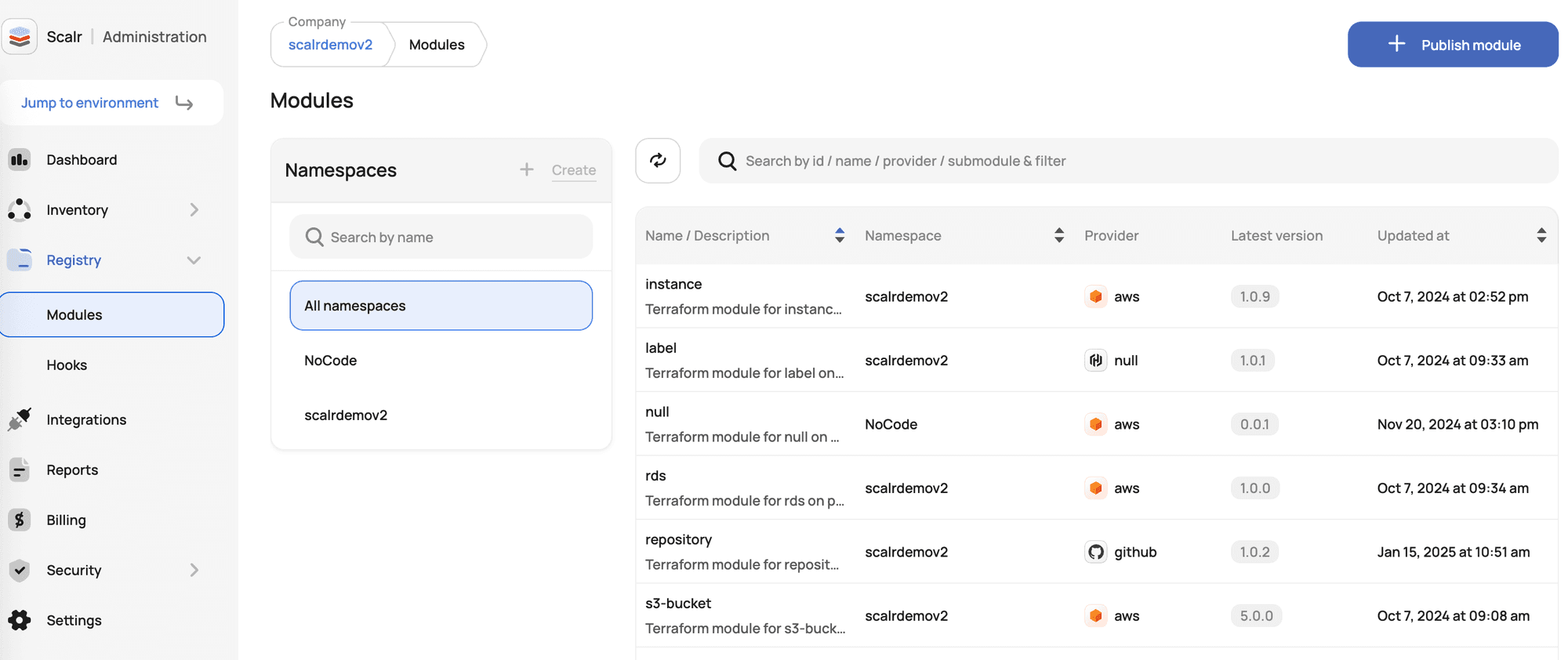
Terraform Modules Explained
- Terraform Registry: Public vs Private Module Registries Explained
- New Feature: Private Module Registry Namespaces
- Dependabot for Terraform Modules: The Complete Setup Guide
- Use local execution mode for free with Scalr
- Scaling Terraform Modules
- Scalr offers a free private module registry
- Terraform Modules - Define, Enforce, Report
- Don't Build a Service Catalog
- Getting Started with Terraform Modules
- Terraform Credential Helper With Scalr
- New Feature: Deploy Terraform Modules From A Service Catalog