

Article · part of a guide
Don't Build a Service Catalog
Transformation is hard. Skip the service catalog and you can start making meaningful change now.

Key takeaways
- A traditional service catalog during a Terraform transformation tends to recreate legacy IT bottlenecks, with a few engineers becoming the bottleneck instead of delivering real change.
- Self service means enabling teams to work autonomously through controls like isolated environments, OPA policies, reporting, and an extensive IAM model, not building a self-service catalog.
- The goal should be self service enablement rather than a self service catalog.
- Solutions like backstage.io or a module registry work better than a service catalog because they are designed around developer experience and teach the fundamentals and process.
Service catalogs are great, right? They give you an easy button, they help you standardize, and they let anyone deploy infrastructure no matter their technical skill. I love easy buttons and I love standardization. What I don't love is the crutch that a service catalog becomes.
I've had too many calls where a prospect tells me they're in the middle of a transformation. They're moving to Terraform. And then, by the way, do you have a service catalog? It's a bit of an oxymoron. If you're in the middle of a transformation and asking for a service catalog, you're probably transforming right back to legacy IT.
Years ago at Scalr we had a "template registry" feature (the name doesn't even make sense..) that had nice big icons, descriptions, the shopping cart experience…. It was great! You would click a few buttons, Terraform runs in the background, and users would get information about their resources. It was great until we showed it to a few of our advanced customers and they instantly asked us to remove it.
Why you ask?
A transformation is a transformation. Just because you have Terraform on the backend being managed by a few people doesn't mean you have transformed. Those few engineers will end up being the bottleneck one day.
Self service doesn't mean a self service catalog. Self service means you've enabled your teams to work autonomously because you put the right controls in place:
- Having isolated environments in which your development teams can operate independently without having to worry about stepping on each other's toes.
- Creating and enforcing OPA policies to ensure the teams are complying with standards.
- Generating reports to understand how your Terraform modules, providers, and other objects are being used.
- Getting the right data to the right place to make sure your DevOps team is working efficiently.
- Allowing teams to use existing workflows, but having the end result being Terraform executing in a remote backend.
- Having an extensive IAM model to allow them to do their job in a secure fashion.
The goal should be self service enablement, not a self service catalog.
That being said, I know it's hard to find good DevOps engineers and not everyone is ready to be an expert in Terraform. That's why the popular backstage.io exists. That's why, at Scalr, we created a module registry that users can deploy from. The difference is that these solutions are designed around the developer experience. Just because someone can't write the Terraform code doesn't mean they shouldn't understand the fundamentals, the process, and the standards the organization follows.
This is a very different approach from a traditional service catalog, a shim on top of an API, or the entry point from an ITSM tool. Showing your users the fundamentals and the process will help speed up the transition.
About the author

director of platform engineering at Scalr
Ryan Fee is the director of platform engineering at Scalr, with over 15 years of experience improving infrastructure experiences at companies large and small.
Part of this guide
13 sheets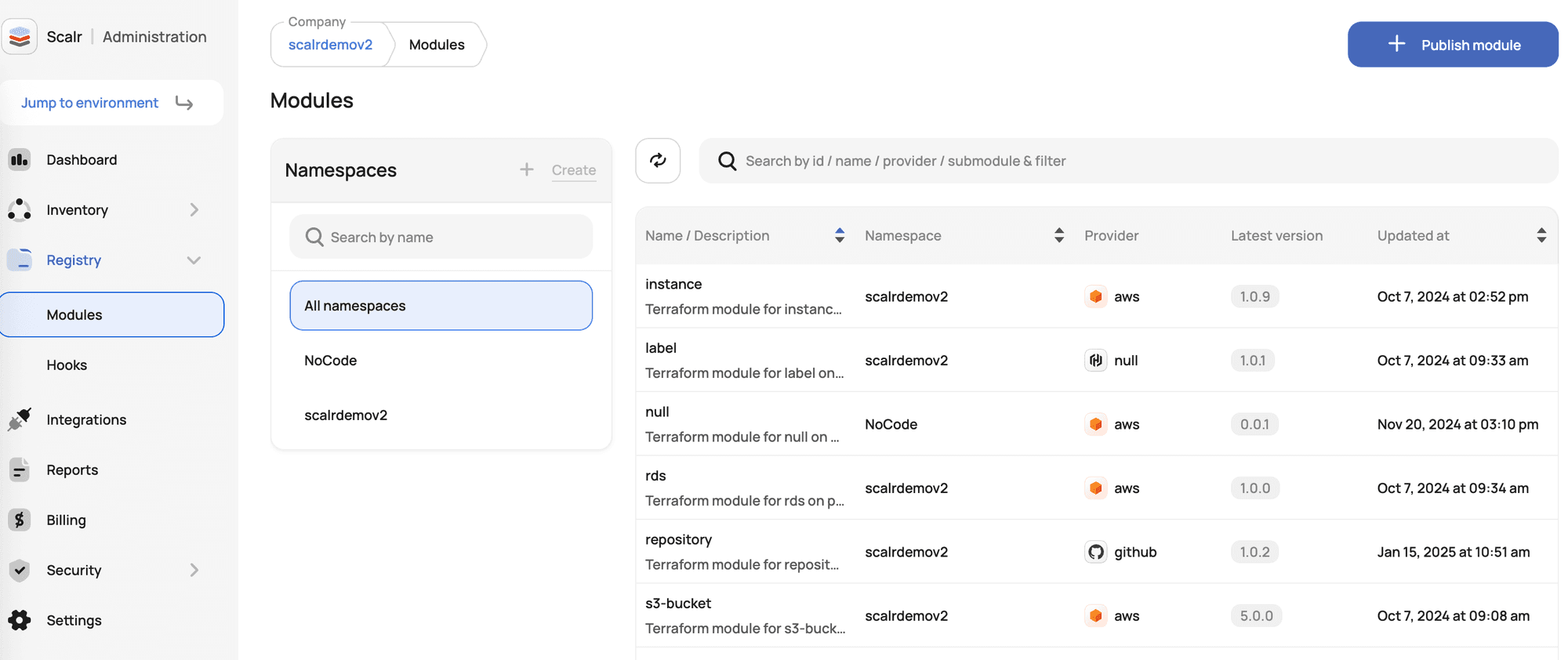
Terraform Modules Explained
- Terraform Registry: Public vs Private Module Registries Explained
- New Feature: Private Module Registry Namespaces
- Top 10 Most Popular Terraform Modules [2026]
- Dependabot for Terraform Modules: The Complete Setup Guide
- Use local execution mode for free with Scalr
- Scaling Terraform Modules
- Scalr offers a free private module registry
- Terraform Modules - Define, Enforce, Report
- Getting Started with Terraform Modules
- Terraform Credential Helper With Scalr
- New Feature: Deploy Terraform Modules From A Service Catalog