

CI/CD and GitOps for Terraform & OpenTofu
Comprehensive guide to building reliable CI/CD pipelines and implementing GitOps workflows for Terraform and OpenTofu infrastructure automation.

- Separate plan and apply into distinct pipeline stages with human approval between them, and treat the plan output as an immutable artifact so the applied change matches exactly what was reviewed.
- Store state in an encrypted remote backend with locking and access controls — state files hold provider tokens, database passwords, and private keys in plaintext by default.
- Inject secrets at runtime through OIDC, secret managers, or pipeline-native stores; with OIDC, prefer file-based token delivery so tokens are re-issued fresh after long approval waits, and pin cloud trust policies to immutable workspace and environment IDs rather than names.
- Profile slow pipelines with TF_LOG=trace before resizing runners — pre-plan validation steps and live data-source refresh across many providers are the usual cost, not memory.
- Pick the CI tool that fits your ecosystem (GitHub Actions, GitLab CI, Azure DevOps, Jenkins) and layer IaC-specific patterns on top rather than fighting its defaults.
- Combine policy-as-code for prevention with scheduled drift detection for verification, and tier your testing (static → unit → integration → E2E) to keep feedback loops tight.
Infrastructure as Code (IaC) deployments require a fundamentally different CI/CD approach than traditional software. This guide assumes you have already chosen your engine; if you are still deciding, start with OpenTofu vs Terraform. Organizations using Terraform and OpenTofu need specialized pipeline strategies that address state management, security, and environmental promotion while maintaining deployment reliability. The most successful implementations combine specialized testing frameworks like Terratest with policy-as-code guardrails, secure state storage, and environment-specific approval workflows—all while balancing speed and safety. Forward-thinking teams are increasingly adopting ephemeral environments, state-aware caching strategies, and automated drift detection regardless of whether they choose commercial CI/CD platforms like GitHub Actions or open-source alternatives.
Why CI/CD for Infrastructure as Code Matters
The Unique Challenge of IaC Automation
Infrastructure as Code automation brings new security challenges that many organizations overlook. A compromised IaC pipeline can compromise your entire cloud environment. Unlike application security vulnerabilities that might impact a single service, IaC security failures have amplified consequences:
- IaC pipelines typically run with highly privileged credentials
- A single misconfiguration propagates across all environments instantly
- Attackers targeting these pipelines inherit the same elevated access privileges
The difference between infrastructure automation and traditional application deployment lies in state awareness. Unlike stateless application deployments, infrastructure changes maintain persistent state that must be carefully managed across pipeline runs. This persistent state creates both opportunities for consistency and risks if mishandled.
Core Principles Driving Successful IaC Pipelines
Effective Terraform and OpenTofu pipelines follow principles distinctly different from traditional application CI/CD:
State Awareness: Unlike stateless application deployments, infrastructure changes maintain persistent state that must be carefully managed across pipeline runs.
Separation of Concerns: Successful IaC pipelines implement initialization patterns that authenticate to backend providers before any other operations. Most high-performing teams separate the plan and apply phases completely, treating the plan output as an immutable artifact that gets approved before application. This prevents "planning twice" problems where the applied changes differ from what was reviewed.
Principle of Least Privilege: Pipeline service accounts should receive narrowly-scoped permissions for exactly the resources they need to manage. For organizations managing multiple environments, implementing a solid promotion strategy is essential.
Environment Promotion Strategies: Organizations managing multiple environments typically follow one of two models:
- Sequential promotion: Changes flow dev→staging→prod
- Parallel approval: Same code deploys to all environments but with different approvers
Each model has tradeoffs between deployment speed, safety, and operational complexity.
Pipeline Architecture Patterns
Project Structure for Success
Project structure significantly impacts pipeline performance and maintainability. The most effective structure pattern for medium to large deployments is a modular mono-repo with environment-specific configuration directories:
terraform-infrastructure/
├── modules/          # Reusable infrastructure components
│   ├── networking/
│   ├── compute/
│   └── database/
├── environments/     # Environment-specific configurations
│   ├── dev/
│   ├── staging/
│   └── production/
└── pipelines/        # CI/CD workflow definitions
For larger organizations, a composition-based approach prevails—creating small, focused repositories for individual modules, then composing them via a separate environments repository. This supports specialized teams working independently while maintaining deployment cohesion.
The Plan-Apply-Approval Pattern
The most successful Terraform pipeline pattern implements a distinct separation between plan and apply stages, with human approval in between:
- Code Validation and Security Scanning (Initial): Syntax checking, linting, and security analysis
- Terraform Plan Generation (Pre-approval): Create and store plan artifact
- Approval Gate with Plan Visualization (Human Intervention): Review proposed changes
- Terraform Apply (Post-approval): Execute using approved plan file
This pattern ensures that changes are explicitly reviewed before execution and prevents "planning twice" where the applied changes differ from what was reviewed.
Performance Optimization at Scale
For large-scale deployments where performance is critical, leading organizations implement:
- Targeted Planning: Running plans only on modified components
- State-Aware Parallelization: Running non-dependent module deployments concurrently
- Provider Caching: Reducing repeated provider download time
- Plan Caching: Avoiding redundant planning operations
Google reports 89% faster Terraform CI/CD pipelines by implementing these optimization techniques at scale.
Before any of that, profile the pipeline. A team Scalr helped migrate off Terraform Cloud hit plans dying with The operation was cancelled after reaching the timeout of 15 minutes and assumed the runner was memory-starved — their first request was for more RAM. A TF_LOG=trace breakdown said otherwise. Init was cheap: all 10 providers came from cache, plugin initialization took 17.3 seconds, and 31 modules resolved in 1.7 seconds, with zero memory pressure anywhere. The time went to two places nobody had looked: a pre-plan validate integration eating 189.6 seconds (about 3.2 minutes) — a step Terraform Cloud had never run for them — and roughly 10.4 minutes of plan time refreshing live data sources across all ten providers (AWS, PagerDuty, Sentry, Coralogix, Checkly, Vercel, and others). Raising the timeout and disabling the redundant validate step brought the run in around 9m40s. The plan had been correct the entire time: 10 to add, 10 to change, 3 to destroy. The instinct to throw hardware at a slow pipeline is usually wrong until a trace log says otherwise — data-source refresh and bolted-on validation steps are the common cost, and neither responds to RAM.
GitOps Principles for Terraform and OpenTofu
GitOps represents a paradigm shift in infrastructure management where Git becomes the single source of truth for both application configuration and infrastructure state. For IaC tools like Terraform and OpenTofu, GitOps workflows enable:
GitOps Workflow Models
Merge-Before-Apply Pattern:
- Changes are proposed via pull/merge request
- The platform automatically runs a plan and reports output
- After code review and merge into the main branch, the apply operation proceeds
- This ensures that only approved code is applied to infrastructure
Apply-Before-Merge Pattern (Plan-and-Apply on PR):
- Teams can view the impact of changes and apply them from a feature branch before merging
- Useful for iteration in development environments or validating changes prior to mainline integration
- Similar to the Atlantis workflow pattern
GitOps Benefits for IaC
- Complete Audit Trail: Every infrastructure change is tracked in Git history with full context
- Declarative Infrastructure: Git becomes the source of truth for desired state
- Collaboration and Review: All changes go through code review before execution
- Rollback Capability: Easy rollback by reverting to previous Git commits
- Environment Consistency: Identical processes for development, staging, and production
VCS Integration Points
Modern GitOps platforms support multiple trigger mechanisms:
- Push-based triggers: Automatically plan/apply when code is pushed to specific branches
- Pull request triggers: Run speculative plans on PR creation, showing impact before merge
- Tag-based triggers: Deploy when version tags are created
- Manual triggers: Allow on-demand runs via VCS comments or platform UI
Securing State and Sensitive Data
State File Security
The most critical vulnerability in Terraform and OpenTofu deployments involves state files, which store sensitive information in plaintext by default. State files contain:
- Provider authentication tokens
- Database passwords
- Private keys
- API endpoints and configuration details
Best Practice: Remote backend with encryption and access controls
Remote state storage with encryption-at-rest is now standard practice, with versioning and access logging enabled. Most major cloud providers offer specialized state storage solutions:
- AWS S3 + DynamoDB: Versioning, server-side encryption, state locking
- Azure Storage: Managed encryption, access control, audit logging
- GCP Cloud Storage: Encryption, versioning, bucket policies
State files should be segmented by environment and bounded context, not by geographic region or arbitrary divisions. This segmentation should align with team boundaries to reduce cross-team dependencies during deployments.
Secrets Management
The consensus approach involves avoiding storing sensitive values in Terraform variables entirely. Instead, leading organizations inject sensitive values at runtime through:
- Secret Management Systems: HashiCorp Vault, AWS Secrets Manager, Azure Key Vault
- Pipeline-Native Secret Stores: GitHub Actions Secrets, GitLab CI Variables, Azure DevOps Variable Groups
- External Identity Providers: AWS IAM Roles, Azure Managed Identities, OIDC tokens
OIDC removes long-lived secrets from the pipeline, but short-lived tokens interact badly with the long pauses built into plan-approve-apply workflows. A Scalr customer running an AzureRM workspace on OIDC had a custom hook calling az login --federated-token $ARM_OIDC_TOKEN, and it worked for so long nobody remembered the hook existed — until the token environment variable came up empty (echo "${#ARM_OIDC_TOKEN}" printed 0). The platform had moved to file-based token delivery on purpose: handing scripts a path (ARM_OIDC_TOKEN_FILE_PATH) instead of a value means the token is re-read fresh at execution time rather than expiring while a plan sits waiting for a human to approve it. The provider handles the file transparently; the custom hook did not. The fix was one line — --federated-token "$(cat $ARM_OIDC_TOKEN_FILE_PATH)" — but the lesson generalizes: any script that captures identity material directly inherits the token-lifetime problem the platform already solved.
On the cloud side, pin OIDC trust policies to immutable identifiers. An enterprise customer building AWS IAM trust policies asked how to match claims on IDs rather than names; the JWT carries claims like "...:scalr_environment_id": "env-xxxx" and "...:scalr_workspace_id": "ws-xxxx" for exactly this reason. Scope trust conditions to those IDs and a workspace rename can no longer widen — or break — the trust boundary.
Provider Authentication Vulnerabilities
Hard-coded credentials represent a critical security risk:
# Dangerous: Hard-coded credentials
provider "aws" {
  access_key = "AKIAIOSFODNN7EXAMPLE"  # Never do this!
  secret_key = "wJalrXUtnFEMI/K7MDENG/bPxRfiCYEXAMPLEKEY"
}

# Better: Use environment variables or IAM roles
provider "aws" {
  # Uses environment variables or instance profile
}
Pipeline-Level Security Controls
Modern IaC management platforms provide:
- Centralized state management with encryption and access controls
- Secure credential management without exposing sensitive values
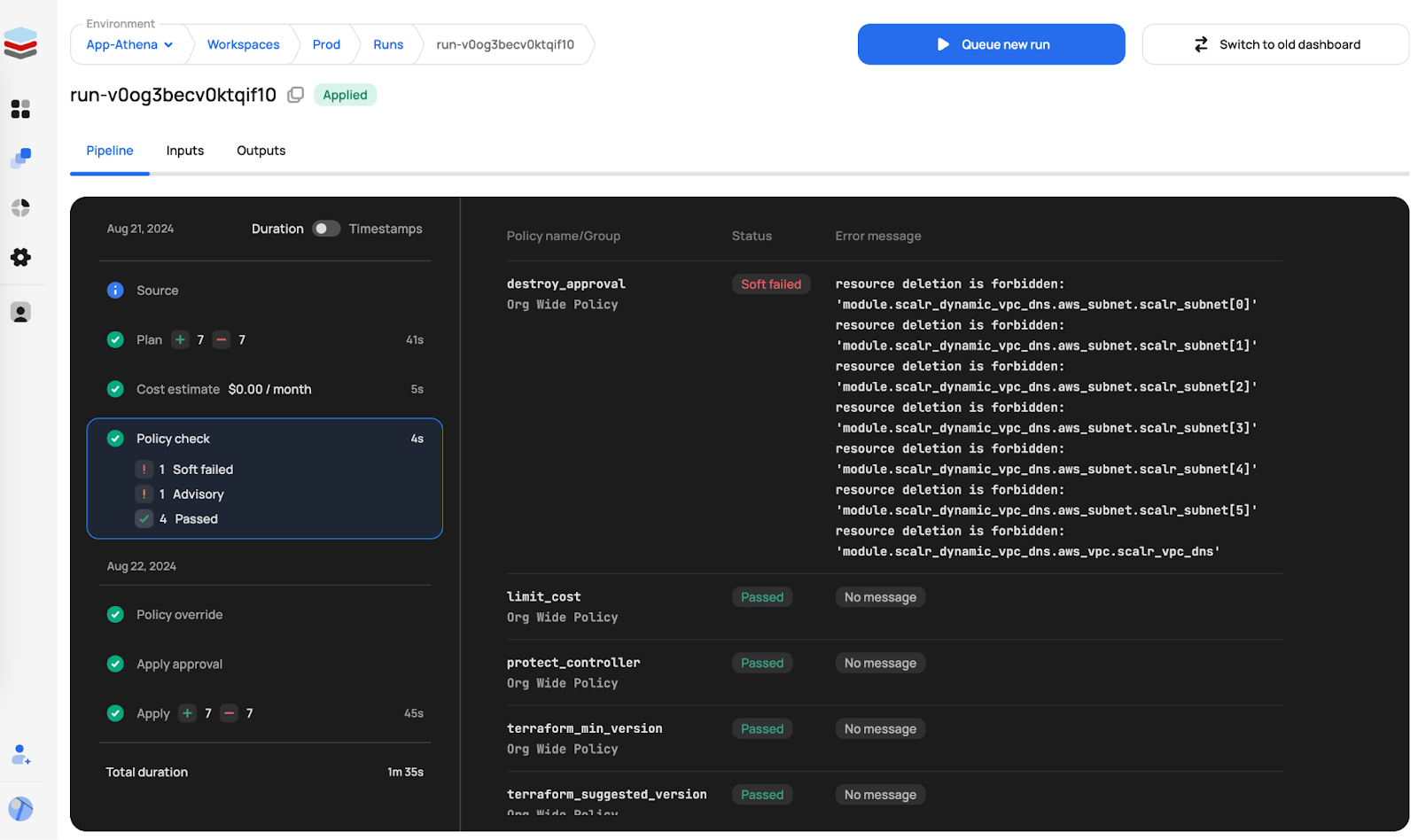
- Policy enforcement that prevents non-compliant infrastructure changes
- Runtime drift detection to identify unexpected changes
GitHub Actions Integration
GitHub Actions provides native integration with repositories, simplified secret management, and a rich marketplace of Terraform-specific actions. The platform excels for organizations on GitHub Enterprise.
Key Advantages
- Native Repository Integration: Direct access to repository code and pull requests
- Matrix-Based Concurrency: Particularly valuable for organizations deploying to multiple regions or accounts
- Rich Terraform Marketplace: Extensive community actions for Terraform operations
- Secret Management: Built-in GitHub Secrets with automatic injection into workflows
- Free for Public Repositories: Generous free tier for open-source projects
Typical Workflow Structure
name: Terraform CI/CD

on:
  pull_request:
    paths:
      - 'terraform/**'
  push:
    branches:
      - main
    paths:
      - 'terraform/**'

jobs:
  plan:
    runs-on: ubuntu-latest
    steps:
      - uses: actions/checkout@v4
      - uses: hashicorp/setup-terraform@v2
      - run: terraform init
      - run: terraform plan -out=tfplan
      - uses: actions/upload-artifact@v3
        with:
          name: tfplan
          path: tfplan

  apply:
    needs: plan
    runs-on: ubuntu-latest
    if: github.ref == 'refs/heads/main'
    environment: production
    steps:
      - uses: actions/checkout@v4
      - uses: hashicorp/setup-terraform@v2
      - uses: actions/download-artifact@v3
        with:
          name: tfplan
      - run: terraform init
      - run: terraform apply -auto-approve tfplan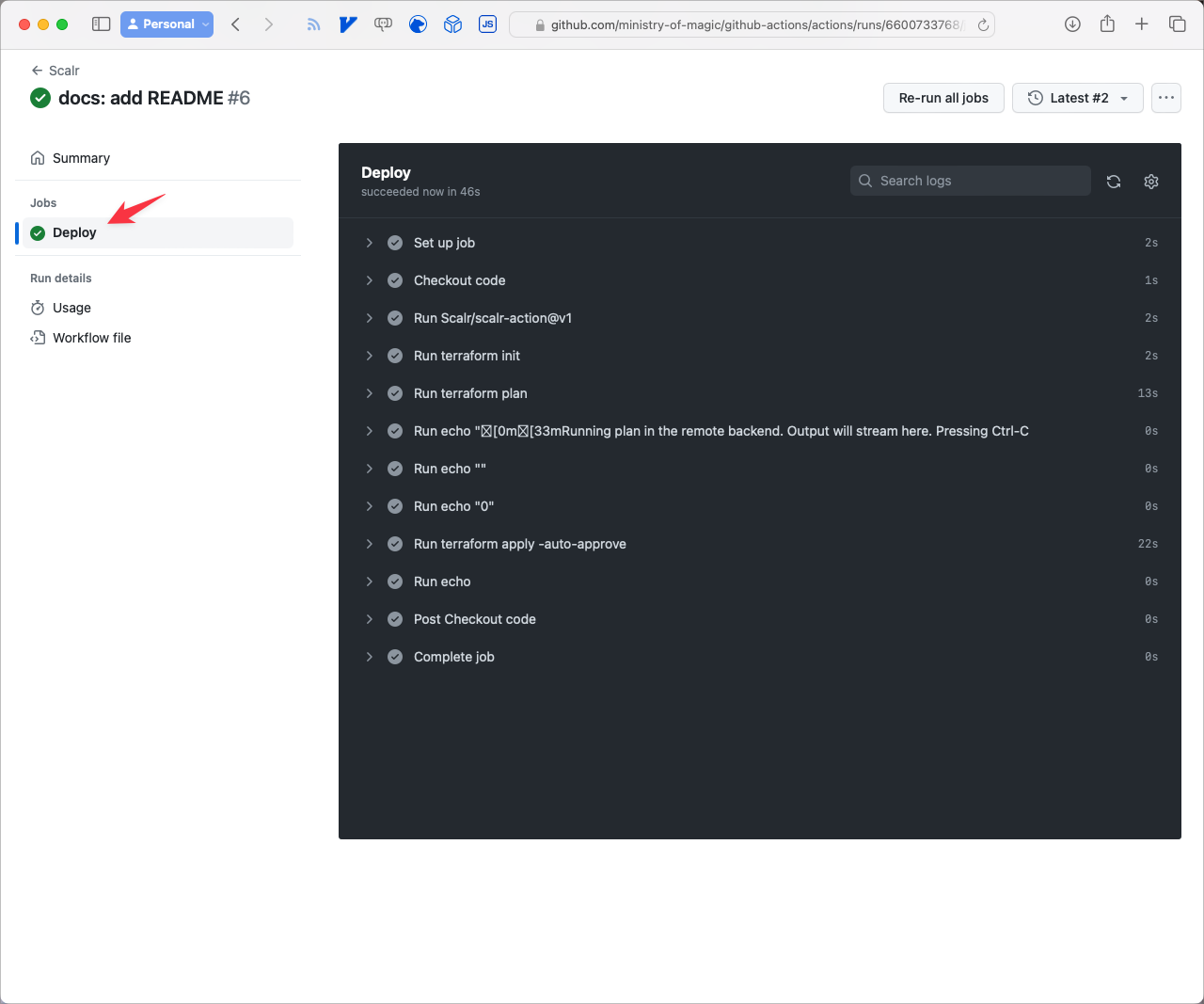
GitLab CI Integration
GitLab CI offers superior native branch protection rules and approval workflows. Its directed acyclic graph (DAG) pipeline architecture is particularly valuable for complex infrastructure deployments with interdependencies.
Key Advantages
- Superior Branch Protection: Native integration with merge request workflows
- DAG Pipeline Architecture: Better handling of complex dependencies
- Built-in State Management: Optional managed Terraform state in GitLab
- Policy as Code: Native integration with policy enforcement tools
- Comprehensive Audit Logging: Detailed records of all infrastructure changes
GitLab GitOps Workflow
GitLab supports both merge-before-apply and apply-before-merge patterns through its merge request pipeline system. Speculative plans can be run on every MR, with results embedded directly in the MR interface for reviewer visibility.
For more detailed information, see our guides on using Terraform with GitLab and managing GitLab itself with Terraform.
Azure DevOps Pipelines
For organizations already heavily invested in Microsoft ecosystems, Azure DevOps offers simplified authentication and tight integration with Azure infrastructure.
Implementation Approach
Azure DevOps uses YAML-based multi-stage pipelines with native support for Terraform. The platform provides several advantages:
- Native Azure Integration: Simplified authentication to Azure resources
- Service Connections: Built-in service principal management
- Variable Groups: Centralized secret management
- Protected Environments: Approval gates with audit logging
- Stage Artifacts: Plan artifacts passed between stages
Multi-Stage Pipeline Pattern
A production-ready pipeline typically implements:
- Validation Stage: Code syntax, formatting, and security scanning
- Plan Stage: Generate and store execution plan as artifact
- Approval Gate: Manual review with protected environment
- Apply Stage: Execute using approved plan artifact
The critical pattern separates plan and apply into distinct stages with human approval between them, preventing accidental changes and ensuring auditability.
Jenkins and Other CI/CD Tools
Jenkins remains relevant for organizations with complex, custom deployment needs, offering unmatched flexibility but requiring more maintenance.
Jenkins Advantages
- Extreme Flexibility: Highly customizable for unique requirements
- Mature Ecosystem: Extensive plugin ecosystem for integration
- Self-Hosted Control: Full control over execution environment
- Complex Workflow Support: Excellent for interdependent infrastructure provisioning
Open-Source Alternatives
Drone CI offers a container-native approach that simplifies Terraform version management and plugin handling. Its stateless nature fits well with immutable infrastructure principles.
Tekton provides a Kubernetes-native pipeline solution that scales exceptionally well for very large infrastructure deployments.
Concourse CI excels at complex resource dependencies and has a strong Terraform user community with many shared pipelines.
Security in CI/CD Pipelines
A compromised IaC pipeline represents one of the most dangerous attack vectors in modern infrastructure. Defense-in-depth strategies are essential.
Key Security Tools
| Security Need | Open-Source Option | Enterprise Solution | Key Capabilities |
|---|---|---|---|
| Static Analysis | tfsec, Checkov | Scalr, Terraform Cloud | Scan IaC templates for vulnerabilities before deployment |
| Policy Enforcement | Open Policy Agent | Scalr, Terraform Enterprise | Prevent non-compliant resources from being created |
| State Management | Remote backends | Scalr, Terraform Cloud | Encrypted state storage with access controls |
| Drift Detection | terraform plan | Scalr, Prisma Cloud | Identify unauthorized infrastructure changes |
| Secrets Management | HashiCorp Vault | Scalr, AWS Secrets Manager | Secure credential management without exposure |
Defense-in-Depth Strategy
Secure CI/CD Pipeline Configuration:
- Isolate build environments
- Use ephemeral credentials
- Validate all external dependencies
- Restrict network access from pipeline runners
Principle of Least Privilege:
- Create purpose-specific service accounts
- Use temporary credentials
- Implement just-in-time access
- Scope permissions to exactly what's needed
Enforce Security Policies as Code:
- Codify compliance requirements in policy frameworks
- Automate policy checks in pipeline stages
- Block deployments that violate security policies
- Maintain audit trail of policy violations
Continuous Monitoring and Verification:
- Regular drift detection across all environments
- Compliance validation at deployment time
- Security posture assessment and reporting
- Alert on anomalies and suspicious activities
Scalr CI/CD Capabilities
Scalr is a platform designed specifically for Terraform and OpenTofu operations. While not a general CI/CD tool, Scalr provides extensive CI/CD-like features for infrastructure automation.
Core CI/CD Functionality
Scalr automates standard Terraform and OpenTofu commands (init, plan, apply), reducing manual intervention and potential errors. It integrates with version control systems, supporting GitOps workflows through two primary models:
Merge-Before-Apply: Changes proposed via PR, reviewed, then applied after merge.
Apply-Before-Merge: Teams validate changes from feature branches before mainline integration, similar to Atlantis.
Custom Hooks for Workflow Extension
Standard IaC workflows often require steps beyond automated plans and applies. Scalr's custom hooks allow integration of custom scripts at various stages:
- Pre-init: Execute scripts before backend initialization
- Pre-plan: Run scripts before plan operation (static analysis, compliance checks)
- Post-plan: Execute after plan generation (cost estimation, notifications)
- Pre-apply: Run before apply operation (final validation, security checks)
- Post-apply: Execute after apply completion (notifications, integration tests, CMDB updates)
Run Triggers and Dependencies
Infrastructure components often have dependencies requiring coordinated provisioning. Scalr's run triggers manage these:
- Workspace Chaining: Successful runs in one workspace trigger runs in dependent workspaces
- Output Dependencies: Workspace B automatically re-plans when Workspace A applies
- Federated Environments: Create dependencies between workspaces in different environments
- VCS Event-Based Triggers: Initiate runs based on branch pushes or tag creation
This cross-workspace run triggering is comparable to features in Terraform Cloud for managing infrastructure dependencies.
Event-Driven Integrations
Scalr supports native integrations for building sophisticated automation:
AWS EventBridge:
- Trigger automated remediation based on run failures
- Orchestrate complex multi-step workflows with Lambda
- Enforce compliance checks on workspace creation
Datadog Integration:
- Correlate infrastructure changes with application behavior
- Monitor IaC pipeline health with custom dashboards
- Audit security-sensitive infrastructure changes
Slack & Teams Integration:
- Route context-aware notifications to appropriate channels
- Streamline code reviews with plan output in PR threads
- Provide stakeholder visibility on deployment progress
Customizable Execution Environments
Scalr supports both managed execution and self-hosted agents:
- Network Access: Deploy agents within private networks for access to internal resources
- Custom Tooling: Install additional binaries, CLI tools, and dependencies
- Compliance and Security: Ensure code and credentials remain in controlled network perimeter
Self-hosted agents add no platform cost: Scalr's per-run pricing includes private agents at no extra charge.
Self-hosted execution comes with failure modes of its own, mostly around container images and isolation semantics. A platform team we worked with at Scalr, running Docker agents on ECS, watched every module pull from public GitHub fail with fatal: unable to access 'https://github.com/...': Problem with the SSL CA cert (path? access rights?) — git exit code 128, on every run. Their workaround, GIT_SSL_NO_VERIFY=true, is a flare rather than a fix, and the failures traced to two real bugs: the 1.0.0 Kubernetes agent ran tasks in an execution environment that had no CA certificates, and the slim agent image shipped without the ca-certificates package entirely. The fuller image had the certs, but its bundled tooling tripped the team's security scanners — the tension between slim images and kitchen-sink images bites from both directions. Both bugs were patched in 1.0.1, released the next day. If you build custom runner images, treat the CA bundle as a first-class dependency rather than something the base image probably includes.
Isolation is the other recurring surprise. A Scalr customer customizing self-hosted runners needed runs to read and write a host directory, and found that volume mounts into the agent container never appeared inside runs: with the Docker driver, each operation executes in its own per-run container, by design. Switching the agent to SCALR_AGENT_DRIVER=local runs operations inside the agent container itself, so mounts work — at the cost of a shared environment between runs. If you take that route, the isolation-preserving pattern is concurrency of 1 per agent, scaling out with replicas, so no two runs ever share a filesystem mid-flight. Sandboxed runs versus a shared environment is an explicit trade-off; know which one you have chosen.
Testing in CI/CD Pipelines
Terraform testing has matured significantly, with a multi-layered approach now considered best practice.
Testing Strategy Layers
1. Static Validation: Syntax checking, formatting validation, lint rules
- Fast feedback on every commit
- Catches obvious configuration errors
- Enforces code standards
2. Unit Testing: Individual module validation with mock providers
- Terraform's built-in
terraform testcommand (v1.6+) provides native module testing - Validates module logic without resource creation
- Fast execution for tight feedback loops
3. Integration Testing: Actual resource creation in isolated environments
- Terratest framework enables testing real cloud resources
- Validates behavior in actual cloud environment
- Runs on major branch merges or releases
4. End-to-End Testing: Complete environment provisioning tests
- Full application stack validation
- Integration testing between infrastructure components
- Post-deployment smoke tests
Tiered Testing Strategy
Organizations balancing speed and safety implement tiered approaches:
- Lightweight static tests run on every commit
- Comprehensive integration tests run only on main branch merges or release preparations
- This approach keeps feedback loops tight while ensuring thorough validation
The key insight: validate behavior, not syntax alone. Testing should verify that infrastructure actually behaves as expected—networks properly segment traffic, security groups enforce proper isolation, and data stores apply correct encryption.
Modern 2026 Best Practices
Ephemeral Environments
Leading teams increasingly provision temporary environments for testing and validation, then destroy them after use. This approach:
- Reduces costs by not maintaining idle infrastructure
- Improves security by minimizing long-lived credentials
- Enables comprehensive integration testing
- Validates complete deployment workflows end-to-end
State-Aware Caching
Organizations managing large infrastructure implement intelligent caching strategies:
- Cache provider binaries to reduce download time
- Cache validated plans to avoid redundant operations
- Cache module downloads from private registries
- Intelligent invalidation based on configuration changes
Automated Drift Detection
Continuous verification pipelines regularly check for drift between defined and actual infrastructure state. These checks:
- Run on schedules (e.g., nightly) rather than being triggered by code changes
- Alert on unexpected infrastructure modifications
- Trigger remediation workflows automatically
- Provide visibility into infrastructure compliance
GitOps at Scale
Mature GitOps implementations use:
- Infrastructure as Code Repositories: Single source of truth in Git
- Declarative Desired State: All configuration in version control
- Automatic Reconciliation: Platform automatically corrects drift (ArgoCD is the de-facto choice for Kubernetes workloads)
- Policy Enforcement: Compliance checks embedded in workflows
- Progressive Delivery: Gradual rollout with automated validation
Observability and Continuous Verification
Monitoring infrastructure deployments requires different metrics than application deployments. The most informative metrics track:
- Deployment Success Rate: Percentage of successful vs. failed deployments
- Deployment Duration: Time from initiation to completion
- Drift Percentage: How often actual infrastructure differs from defined state
- Resource Change Volume: Number of resources modified per deployment
- Approval Time: How long changes wait for human approval
Leading organizations integrate Terraform outputs directly with monitoring platforms, creating a closed loop where infrastructure metrics inform future deployment decisions.
Conclusion
Building effective CI/CD pipelines for Terraform and OpenTofu requires specialized approaches that differ significantly from traditional application pipelines. The most successful implementations treat infrastructure deployments as critical state transitions rather than stateless code deployments. By combining secure state management, comprehensive testing, and environment-specific approval workflows, organizations can achieve both speed and safety in their infrastructure automation.
Whether using GitHub Actions, GitLab CI, Azure DevOps, Scalr, or open-source alternatives, the fundamental principles remain consistent:
- State awareness guides all pipeline design decisions
- Separation of plan and apply ensures auditability and control
- Principle of least privilege minimizes blast radius of compromises
- Comprehensive testing catches issues early
- Security as code enforces compliance automatically
- Continuous verification maintains infrastructure integrity
The right CI/CD platform depends on your organization's specific needs, existing investments, and deployment complexity. However, the architectural patterns and security practices outlined here transcend any particular tooling choice.
Key Takeaways
✓ CI/CD for IaC requires state-aware architecture different from application deployment pipelines
✓ Separate plan and apply stages with mandatory human review to prevent accidental changes
✓ Implement defense-in-depth security including state encryption, credential management, policy enforcement, and drift detection
✓ Choose your platform based on ecosystem fit: GitHub Actions for GitHub shops, GitLab CI for GitLab, Azure DevOps for Microsoft environments, or platform-agnostic tools like Scalr
✓ Multi-layer testing strategies (static → unit → integration → E2E) catch issues early and prevent production incidents
✓ Implement comprehensive observability to track deployment metrics, drift percentage, and approval times
✓ GitOps principles (Git as source of truth, declarative configuration, automatic reconciliation) scale infrastructure automation across teams
✓ Continuous drift detection maintains infrastructure integrity over time regardless of manual changes
Frequently asked questions
How is CI/CD for Terraform and OpenTofu different from application CI/CD?
Infrastructure pipelines are state-aware: every run reads and writes persistent state, typically with highly privileged credentials, so a bad apply persists and a compromised pipeline can compromise the whole cloud account. That changes the design — plan and apply are separated by a human approval gate, state lives in an encrypted remote backend with locking, and secrets are injected at runtime rather than committed.Why should terraform plan and terraform apply be separate pipeline stages?
Separating them with an approval gate prevents the 'planning twice' problem, where what gets applied differs from what was reviewed. The plan is generated once, stored as an immutable artifact, reviewed by a human, and then applied exactly as approved.Why is my Terraform plan timing out in CI even though the runner has plenty of resources?
Profile before resizing. In one case we traced with TF_LOG=trace, init was fast and memory pressure was zero — the time went to a pre-plan validate step (over three minutes) and roughly ten minutes of plan time refreshing live data sources across ten providers. Raising the timeout and removing the redundant validate step fixed it; more RAM would not have.How should secrets be handled in Terraform CI/CD pipelines?
Avoid storing sensitive values in Terraform variables entirely. Inject them at runtime through a secrets manager (Vault, AWS Secrets Manager, Azure Key Vault), pipeline-native secret stores, or short-lived OIDC tokens. If custom scripts consume OIDC tokens, read them from the token file path at execution time so they are fresh after plan-to-apply approval waits.What should I watch for when running Terraform on self-hosted runners or agents?
Two recurring issues: container image hygiene (a slim image missing the ca-certificates package makes every HTTPS module pull fail with an SSL CA cert error — fix the image, never set GIT_SSL_NO_VERIFY=true) and isolation semantics (with a Docker driver each operation runs in its own per-run container, so mounts into the agent container do not propagate; a local driver shares the agent environment, best paired with concurrency of one per agent).What is the difference between merge-before-apply and apply-before-merge GitOps workflows?
Merge-before-apply proposes changes via pull request, runs a speculative plan, and applies only after review and merge — ensuring only approved code reaches infrastructure. Apply-before-merge lets teams apply from a feature branch before merging, useful for iterating in development environments, similar to the Atlantis workflow.