

Article · part of a guide
Integrating Terraform Events w/ AWS EventBridge
Why you should use AWS EventBridge and Scalr together

Key takeaways
- Scalr has a native integration with AWS EventBridge that forwards Terraform run events so you can build event-driven workflows reacting to runs.
- Because runs execute in Scalr, Scalr can send run events to EventBridge automatically, where rules route them to targets like CloudWatch, Lambda, or SNS.
- Common use cases include monitoring and alerting (for example notifying ops on a failed run in a critical environment) and streaming audit logs for compliance and troubleshooting.
- The Scalr-EventBridge integration is configured from the Scalr UI and is available on both free and paid plans.
Plenty of DevOps teams use Terraform to manage AWS EventBridge. Going the other way, using EventBridge to watch Terraform events, comes up far less often. Scalr's native integration with EventBridge lets you build event-driven workflows that react to Terraform events, and this post shows how it works.
Want to see it in action first? Watch the video walkthrough: Scalr Integration w/ AWS EventBridge for Terraform & OpenTofu
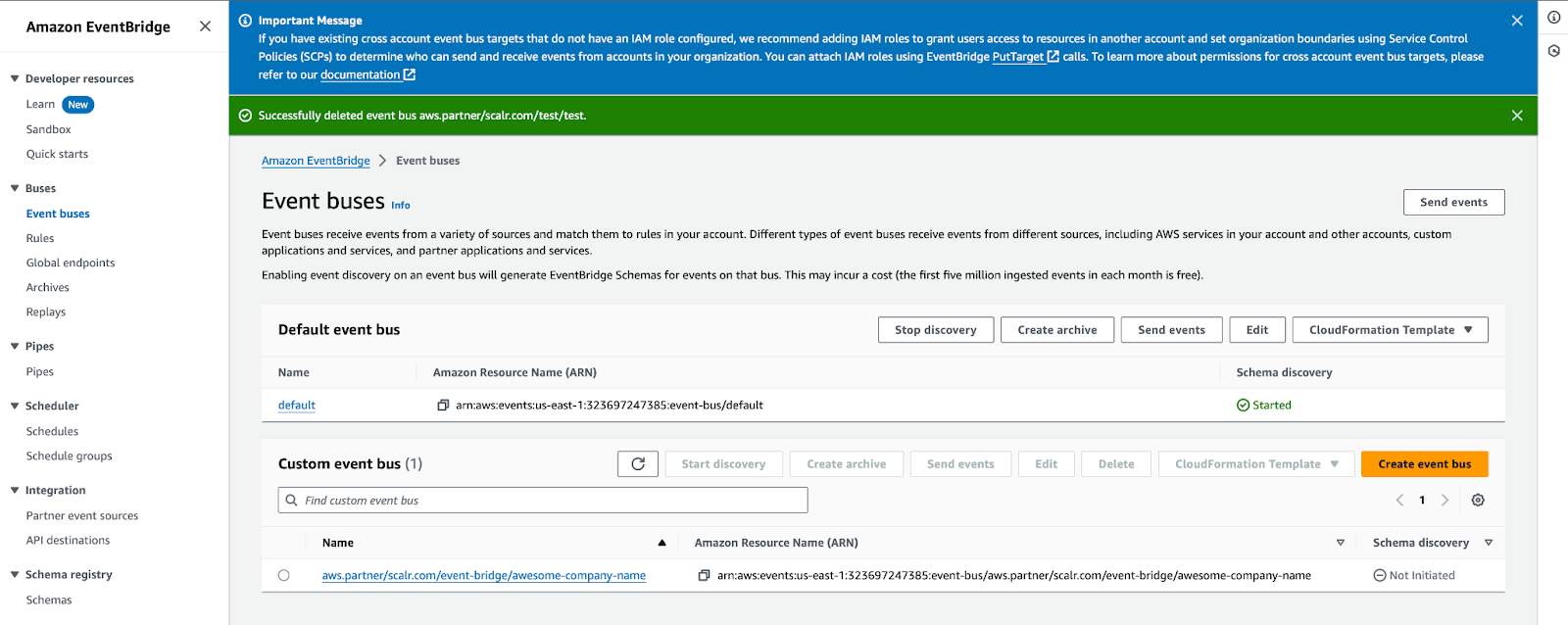
AWS EventBridge Interface
What Is AWS EventBridge?
AWS EventBridge is a serverless event bus that connects your applications with data from different event sources. It takes real-time data from SaaS applications and AWS services and routes it to targets like AWS CloudWatch or Lambda. EventBridge is a common building block for event-driven architectures on AWS.
Key concepts in EventBridge include:
- Event Buses: The "pipeline" that receives events from a source and routes them to a target.
- Rules: Definitions for filtering and routing events to specific targets based on an event pattern.
- Targets: Destinations for events, such as Lambda functions, SNS topics, SQS queues, CloudWatch log groups, etc.
- EventBridge Pipes: Allows you to filter, transform, and enrich events before passing them to a target.
EventBridge integrates with over 90 AWS services as event sources, including CloudWatch, EC2, S3, and CodeCommit, and it integrates with many third-party tools. That makes it easy to build event-driven workflows that react to state changes.
How Does the Terraform EventBridge Module Manage AWS Resources?
Terraform is an infrastructure-as-code tool that lets you provision and manage infrastructure on AWS and other providers through declarative configuration files. Terraform and OpenTofu support the AWS provider with resources for managing EventBridge components.
A few examples of provider and module usage follow; the full documentation is in library.tf.
This example creates an EventBridge bus with the supported module, adds a rule, and sends matching events to a target, in this case AWS CloudWatch:
resource "aws_cloudwatch_log_group" "scalr_runs" {
  name              = "/aws/events/scalr-runs"
  retention_in_days = 30
}

module "eventbridge" {
  source  = "terraform-aws-modules/eventbridge/aws"
  version = "~> 3.0"

  bus_name = "scalr-events"

  rules = {
    scalr_run_failed = {
      description = "Route failed Scalr runs to CloudWatch"
      event_pattern = jsonencode({
        "detail-type" = ["RunExecuted"]
        detail        = { status = ["errored"] }
      })
    }
  }

  targets = {
    scalr_run_failed = [
      {
        name = "send-to-cloudwatch"
        arn  = aws_cloudwatch_log_group.scalr_runs.arn
      }
    ]
  }
}
How Can You Use EventBridge to Monitor Terraform?
You can also go the other direction and use AWS EventBridge to build an event-driven workflow off a Terraform event, like a Terraform apply that fails. The Scalr native integration with AWS EventBridge is what makes this possible.
Common Use Cases
Scalr is a Terraform automation and collaboration tool that runs your Terraform code remotely and integrates with many third-party tools. Because the runs execute in Scalr, Scalr can log events and trigger actions based on them. Two common use cases come up with events sent from Scalr to EventBridge:
Monitoring and Alerting
The Scalr-EventBridge integration lets teams automate work across their tooling. You design EventBridge rules that fire specific actions in response to Scalr and Terraform events. A successful Terraform run could kick off additional resource provisioning. A failed run in a critical environment could page the operations team right away, and finishing a large infrastructure update might trigger an automated test suite.
Audit Logging
Scalr can also stream user activity to EventBridge, not just run events, which gives you a detailed audit log of every account action. That tracking covers resource changes across Scalr services. Teams use the audit trail for a few things:
- Ensuring compliance with regulatory requirements
- Troubleshooting issues by reviewing historical actions
- Analyzing patterns and trends in Scalr usage over time
How Does the Integration Work
Terraform Run Events
Scalr has a pre-built event bus in AWS that can be used for this. The integration is started from the Scalr UI:
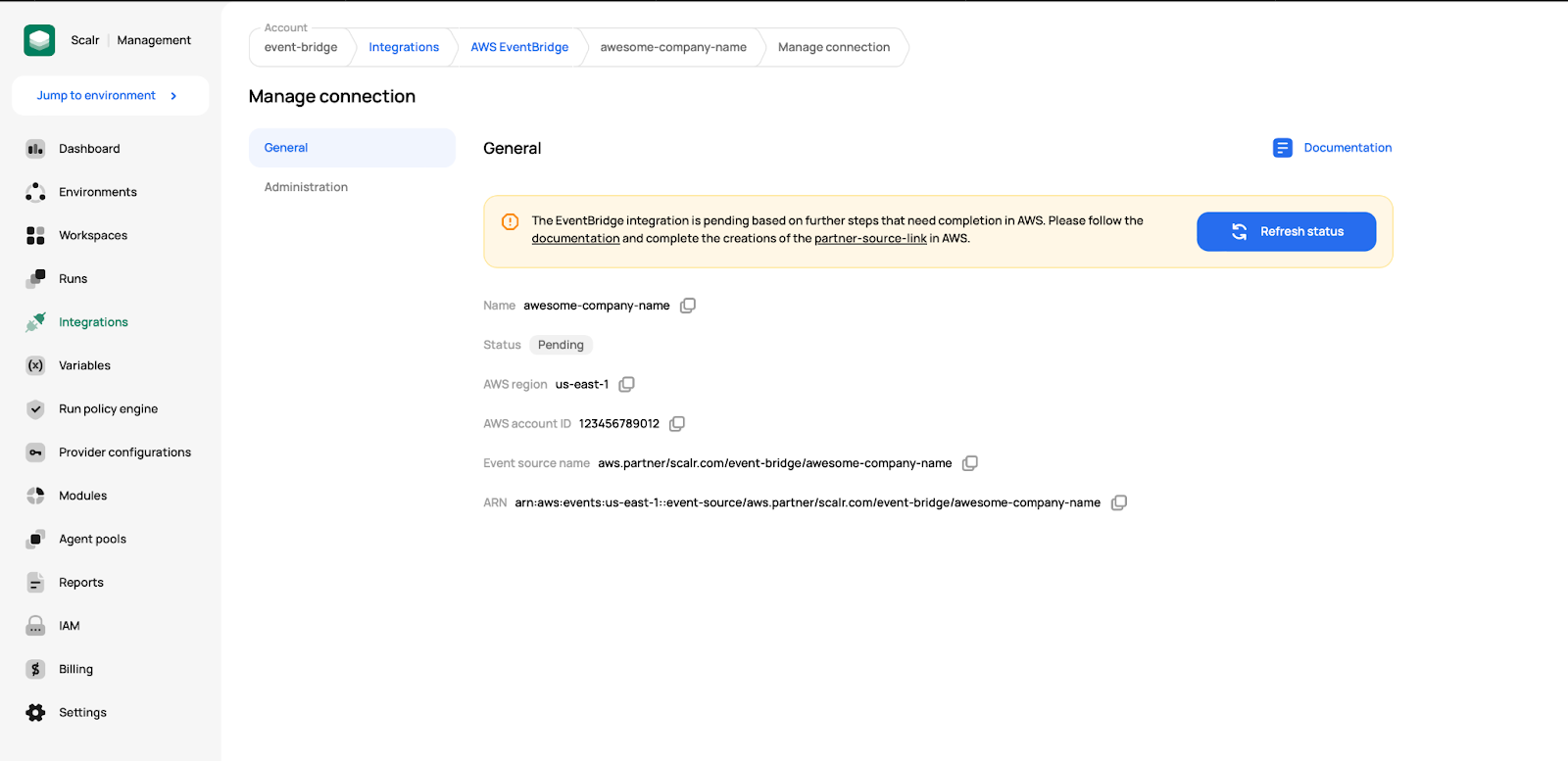
AWS EventBridge Configuration in Scalr
After any Terraform run event in Scalr, Scalr sends the run to EventBridge as a RunExecuted event whose detail carries the run's status, the workspace and environment it belongs to, and how it was triggered (CLI, VCS, or UI). The exact schema is in the integration docs.
An EventBridge bus captures the event, and a rule you create in AWS decides what to do with it. A common use case is to forward this information to an AWS CloudWatch log group so that teams can set up alerts based on Terraform run event failures.
Scalr Audit Logs
Scalr also provides the option to send audit logs to AWS EventBridge. Rather than run events, users can create EventBridge rules based on actions taken in Scalr such as a Terraform workspace deletion, a run being approved, and more. These arrive as AuditLog events whose detail records the actor, the action (for example a workspace deletion or a run approval), the object it touched, and a timestamp, and they're usually forwarded on to CloudWatch or a SaaS tool such as Datadog. If audit-log streaming is ever switched off, Scalr emits an AuditLogDisabled event so the gap doesn't go unnoticed.
See it in Action
Prefer a demo? The video below walks through integrating Scalr with AWS EventBridge to send audit logs and run events:
Scalr Integration w/ AWS EventBridge for Terraform & OpenTofu
Getting Started
You can use Terraform to create EventBridge resources, or use EventBridge to drive workflows off Terraform events. For the second case, Scalr's integration is what gets your Terraform run events into EventBridge. It's available on both free and paid plans, so you can try it in Scalr. And if you're building out the rest of your delivery workflow, our guide to building Terraform and OpenTofu CI/CD pipelines covers the bigger picture.
Frequently asked questions
Can AWS EventBridge monitor Terraform run events?
Yes, through Scalr's native EventBridge integration. Because Terraform runs execute in Scalr, Scalr automatically sends information about each run event to an EventBridge bus in AWS. Rules on that bus then route the events to targets like CloudWatch, Lambda, or SNS.
What can you build with Scalr run events in EventBridge?
Common patterns are monitoring and alerting: a failed run in a critical environment can page the operations team, a successful run can kick off additional provisioning, and finishing a large update can trigger a test suite. A frequent setup forwards run events to a CloudWatch log group and alerts on failures.
Can Scalr send audit logs to AWS EventBridge?
Yes. Beyond run events, Scalr can stream user activity such as workspace deletions or run approvals to EventBridge, giving you a detailed audit log of account actions. Teams forward these to CloudWatch or tools like Datadog for compliance, troubleshooting, and usage analysis.
How do you set up the Scalr EventBridge integration?
The integration is started from the Scalr UI and uses a pre-built Scalr event bus in AWS. Once configured, Scalr sends run events to EventBridge automatically, and you create rules in AWS to decide where they go. It's available on both free and paid Scalr plans.
About the author

director of platform engineering at Scalr
Ryan Fee is the director of platform engineering at Scalr, with over 15 years of experience improving infrastructure experiences at companies large and small.
Part of this guide
25 sheets
CI/CD and GitOps for Terraform & OpenTofu
- Migrating GitHub Actions from an S3 Backend to Scalr
- tofu test and terraform test: Testing OpenTofu and Terraform Modules
- Custom Hooks for Terraform and OpenTofu: Pre-Plan, Post-Apply, and the Hooks Registry
- Integrating Terraform with Backstage
- The No-Nonsense Guide to ArgoCD
- Top 10 Continuous Delivery Tools
- Top 10 GitOps Tools: A Comprehensive Guide
- Everything you need to know about using Terraform or OpenTofu with Slack
- Using Terraform with GitLab
- Key DevOps Metrics You Should Be Tracking
- Terraform and OpenTofu with Dependabot
- Terraform Notifications in Microsoft Teams
- The Complete Guide to DevOps Monitoring Tools: Choosing the Right Solution for Your Infrastructure
- Top Jenkins Alternatives & Specialized IaC Tools
- Why You Should Use Dependabot with Terraform and OpenTofu
- Mastering Terraform at Scale: A Developer's Guide to Reliable Infrastructure
- How to use the Azure DevOps Terraform Provider
- Deploying your infrastructure with Scalr and GitHub Actions
- Terraform Configuration Ingestion
- Setting up Scalr & Azure DevOps Part 2 - Add Azure credentials
- Setting up Scalr & Azure DevOps Part 3 - Execute Your Terraform Code and Create a Workspace
- Setting up Scalr & Azure DevOps Part 1 - Picking a Workflow
- Terraform Cost Estimation in 2021: The Definitive Guide