

Article · part of a guide
How to use the Bitbucket Terraform Provider
Learn about the Bitbucket Terraform Provider

Key takeaways
- The Bitbucket Terraform provider manages Bitbucket resources like repositories, projects, and groups directly in Terraform code, so repository configuration is codified and version-controlled.
- Because Bitbucket's provider is community-driven rather than officially supported, the post recommends using library.tf to compare providers by update frequency, commits, and contributors before choosing one.
- Bitbucket supports authentication through username and password, an OAuth client ID and secret, or a token.
- Storing Terraform code in a Bitbucket repository enables change tracking, collaboration, history and rollback, branching, and code review.
- Integrating Bitbucket with a TACO like Scalr or Terraform Cloud adds a private module registry, GitOps dry runs and applies, and OPA policy enforcement.
Most infrastructure as code pipelines have two core parts: an IaC platform like Terraform or OpenTofu, and a version control system (VCS) like Bitbucket. Terraform defines and provisions infrastructure through a declarative configuration language, and pairing it with Bitbucket adds a layer of control and collaboration. People usually think of pull request automation when they hear "Bitbucket and Terraform," and the second half of this post covers that. First, though, we'll look at using Terraform to manage your Bitbucket configuration itself, plus the integration Scalr has with Bitbucket.
What Is the Bitbucket Terraform Provider and How Do You Choose One?
What is the Bitbucket Terraform Provider?
Terraform uses providers to talk to endpoint APIs and create resources. The Bitbucket Terraform provider sits between your infrastructure code and Bitbucket Cloud or Bitbucket Datacenter. You use it to define and manage Bitbucket resources (such as repositories and projects) right inside your Terraform modules and code. That means your repository configurations are codified, version-controlled, and easy to reproduce across environments.
Picking the right provider matters here. Tools like Okta and GitLab have officially supported providers, but Bitbucket is community driven, so you want the one that's maintained and used the most. Searching the standard Terraform registry didn't help me much, since it gives you almost nothing to compare on.
Instead, I used library.tf, a registry maintained by Scalr, which gave me enough information to decide which provider to use:
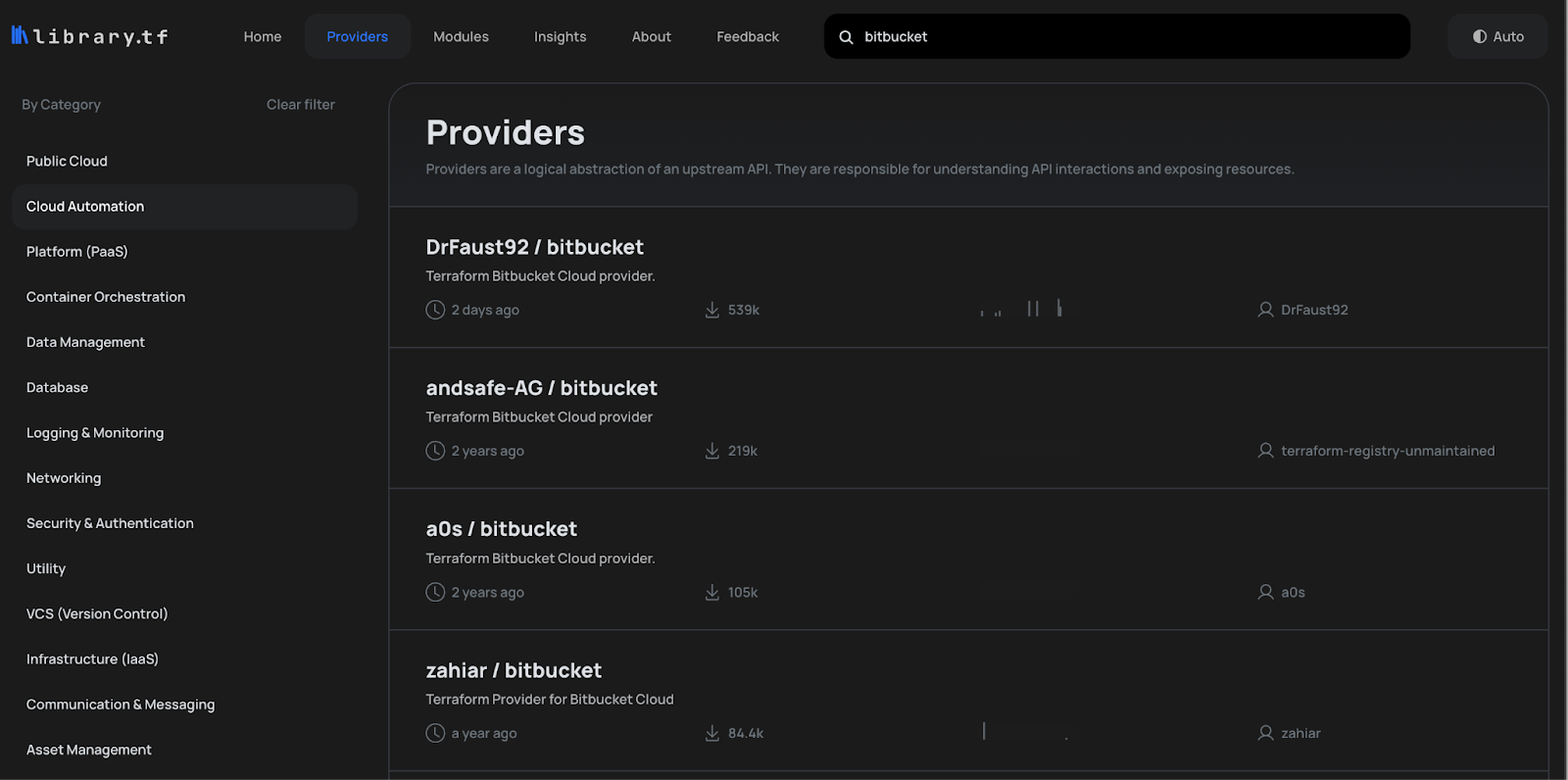
Screenshot of Providers from Library.tf
Only one provider in that list has been updated in the last year and has frequent commits. Clicking into it also shows the number of contributors, open issues, and more, which helped me settle on this Bitbucket provider.
Prerequisites
Before you use the Bitbucket Terraform provider, make sure you have these prerequisites in place:
- Terraform Installed: Make sure you have Terraform or OpenTofu installed on your machine. You can download the latest versions from Terraform or OpenTofu websites.
- Bitbucket Cloud Account: You'll need a Bitbucket account with the necessary permissions to manage Bitbucket resources. If you don't have a Bitbucket account, sign up for one on the Bitbucket website. Bitbucket server is also an option, but we'll focus on Bitbucket cloud in this example.
- Bitbucket secret (optional): Bitbucket supports authentication through a username/password, OAuth client ID and secret, or token.
- Scalr Account: If you want to use Scalr as the remote backend, sign up for a free account here. Feel free to use this as a development environment while you explore Scalr.
How Do You Authenticate and Use the Bitbucket Provider?
The next few steps cover how to authenticate to the provider, then walk through some basic examples of using it.
Define Required Providers and Provider Configuration
Start by configuring the Bitbucket Terraform provider in your Terraform code. Open your Terraform configuration file (commonly named main.tf) and add the following block:
terraform {
  required_providers {
    bitbucket = {
      source  = "DrFaust92/bitbucket"
      version = "~> 2.40"
    }
  }
}

provider "bitbucket" {
  username = "your-username"
  password = "your-password" # an app password; prefer BITBUCKET_USERNAME / BITBUCKET_PASSWORD env vars
}
Replace "your-username" with your Bitbucket username and "your-password" with the password you use for Bitbucket. The latest version of the Bitbucket Terraform provider documentation can be found here.
Manage Repos
Next, create a Bitbucket repository with the Bitbucket Terraform resource. The resource is documented in detail in the Terraform registry here. Add the following code to your configuration:
resource "bitbucket_repository" "example_repo" {
  owner      = "your-workspace"
  name       = "example-repo"
  is_private = true
}
This Terraform code defines a resource "example_repo" that is set to be private.
Manage Groups
This example manages a Bitbucket group and its permissions, and uses a data source to pull the workspace ID:
data "bitbucket_workspace" "this" {
  workspace = "your-workspace"
}

resource "bitbucket_group" "example_group" {
  workspace  = data.bitbucket_workspace.this.id
  name       = "example-group"
  permission = "read"
}
This Terraform code defines a resource "example_group" and sets the group's permission to read.
Run Terraform Commands
Once you've defined your Bitbucket resources through the Bitbucket Terraform provider, navigate to the directory containing your Terraform configuration file and run the following commands:
terraform init
terraform plan
terraform apply
If you are using OpenTofu, use the tofu commands instead:
tofu init
tofu plan
tofu apply
Terraform will initialize the Bitbucket provider and apply the changes to your Bitbucket account. Upon a successful Terraform run, the state file will be created.
What Best Practices Improve Advanced Bitbucket Provider Usage?
Variables and Dynamic Configurations
Use Terraform variables instead of hardcoded values so the same configuration can be reused.
Remote State Management
Consider using remote state management to store your Terraform state files securely. Services like Scalr or AWS S3 can be configured as remote backends to store state files. Here is an example of connecting to Scalr:
terraform {
  backend "remote" {
    hostname     = "my-account.scalr.io"
    organization = "env-xxxxxxxxxxxxxxx" # the Scalr environment ID
    workspaces {
      name = "my-workspace"
    }
  }
}
Data Sources
Bitbucket data sources can pull information from other resources or workspaces into the run.
What Can You Do Next With the Bitbucket Provider?
The provider supports plenty of other Bitbucket resources beyond repositories and groups, such as branches, deploy keys, and projects. The library.tf documentation for the provider is a good place to find more detail and examples.
Once your repositories, projects, and groups live in Terraform code, you create and change them with the same plan-and-apply workflow you already use for cloud infrastructure, and the configuration sits in version control alongside everything else.
How Does Scalr Integrate With Bitbucket?
Bitbucket also plays a part in your overall Terraform pipeline, and it connects to Scalr.
Bitbucket as a VCS Repo
With Terraform and Bitbucket, the number one best practice is to store your Terraform files in a VCS repository like Bitbucket. Once the Terraform configuration lives in a Bitbucket repository, your infrastructure teams get the following:
- Tracking Changes: A VCS keeps track of changes made to Terraform source code files within a Bitbucket repo. Each change is associated with a commit, which includes details such as who made the Terraform code changes, when it was made, and a description of the modifications.
- Collaboration: When several developers work on the same Bitbucket repository at once, each one can make changes independently. The VCS then merges those changes, which prevents conflicts and keeps the Terraform codebase coherent.
- History and Rollback: Because the VCS keeps a complete history of every change to the Terraform code, developers can roll back to a previous version if something breaks, or check when a specific change was introduced.
- Branching and Merging: Branches are independent lines of Terraform code development, which makes them useful for new features, bug fixes, or experimental changes that you don't want touching the main codebase yet. Open a merge request and you can automatically trigger a "Terraform dry run" in tools like Scalr or Terraform Cloud, which executes a Terraform plan and sends the results back into Bitbucket. If those results come back clean, developers merge the code and the changes move from one branch into another.
- Code Review: A VCS shows a clear view of the changes in a commit, so reviewers can assess the modifications, leave comments, and suggest improvements before anything merges into the main branch.
Using Bitbucket with a TACO (Terraform Collaboration and Automation Platform)
If you are looking for a TACO, such as Scalr or Terraform Cloud, to help scale your Terraform operations, the integration with Bitbucket is a key feature. Integrating these tools with Bitbucket lets you pull in the Terraform code and also enables the following features:
- Terraform Private Module Registry: On top of storing your Terraform code in Bitbucket for the reasons stated above, another best practice is to implement a Terraform Private Module Registry to store your Terraform modules. You store your Terraform modules in Bitbucket repos, integrate Scalr or Terraform Cloud with Bitbucket, and then pull the Terraform modules in for your DevOps teams to use. Bitbucket stays the source of truth for the code, and you get a curated list of approved modules for your teams.
- GitOps Workflow: A GitOps workflow for Terraform is usually the goal for most DevOps teams. A GitOps workflow can use the Bitbucket branching and merging to automatically kick off Terraform dry runs as well as Terraform applies. The flow is typically as follows: A branch, let's call it dev, is created based on the main branch. Terraform code is updated in the dev branch. A merge request is opened up against the main branch from dev. Based on the merge request being opened, the TACO will automatically execute a Terraform dry run and send the results back to Bitbucket pipelines. Admins can optionally set branch policies (a best practice) to only allow a merge request if all checks come back successfully from the TACO. Once the merge request is approved the Terraform apply will execute in the TACO.
- Open Policy Agent: Open Policy Agent (OPA) with Terraform enables declarative policy enforcement for the Terraform code, allowing admins to define and enforce fine-grained policies to govern the provisioning workflow. Typically, the OPA policies are stored in Bitbucket and then pulled into Scalr or Terraform Cloud to enforce them in the core workflow.
The TACO products have a full feature set dedicated to Terraform, including the ability to store Terraform state files. See more here.
Frequently asked questions
What is the Bitbucket Terraform provider used for?
The Bitbucket Terraform provider sits between your infrastructure code and Bitbucket Cloud or Bitbucket Datacenter, letting you define and manage resources like repositories, projects, and groups directly in Terraform. Your repository configurations end up codified, version-controlled, and easy to reproduce across environments.
Which Bitbucket Terraform provider should you use?
Bitbucket's providers are community driven rather than officially supported, so pick the one that is maintained and used the most. A registry like library.tf lets you compare providers by recent updates, commit frequency, contributors, and open issues, which the standard Terraform registry does not surface well.
How do you authenticate to the Bitbucket Terraform provider?
Bitbucket supports authentication through a username and password, an OAuth client ID and secret, or a token. You configure these credentials in the provider block of your Terraform configuration file.
Why store Terraform code in a Bitbucket repository?
Storing Terraform configuration in Bitbucket gives teams change tracking tied to commits, collaboration without conflicts, full history with rollback, branching, and code review. Opening a merge request can also trigger a Terraform dry run in a tool like Scalr or Terraform Cloud, with plan results sent back into Bitbucket before the code merges.
About the author

director of platform engineering at Scalr
Ryan Fee is the director of platform engineering at Scalr, with over 15 years of experience improving infrastructure experiences at companies large and small.
Part of this guide
16 sheets
Terraform Providers: Complete Configuration and Management Guide
- How to Manage GitLab with Terraform
- How to use the Terraform Okta Provider
- Mastering Kubernetes with Terraform: A Provider Deep Dive
- Top 10 Most Popular Terraform Providers [2026]
- What are Terraform Lock Files
- AzureRM Terraform Provider Overview
- Kubernetes Terraform Provider
- Terraform Random Provider
- How to use Terraform or OpenTofu to Manage Datadog
- Getting Started with Terraform Providers
- Getting Started with the Google Cloud Terraform Provider
- How to use Terraform to manage Okta
- New Feature: Provider Configurations
- Using A Custom Terraform Provider In Scalr