

Article · part of a guide
Why Use A Remote Operations Backend Over A Standard Backend
Why you should select a remote operations backend such as Scalr or Terraform Cloud over a standard backend.
Key takeaways
- Standard backends, like an S3 bucket or Azure blob storage, only store state files, versions, and locks, leaving engineers responsible for orchestrating Terraform runs.
- Remote operations backends such as Scalr and Terraform Cloud add three main capabilities on top of state storage: runs, cost estimation, and policy enforcement with audit evidence.
- Cost estimation runs during the plan phase so engineers see the potential cost of changes before deploying, removing the 'I did not know' situation.
- Policy enforcement uses frameworks like OPA or Sentinel for granular control over how resources are configured and named, which matters in regulated environments; Scalr supports OPA while Sentinel is the HashiCorp-proprietary option used by Terraform Cloud.
- For most teams a remote operations backend is recommended over a standard one because it reduces operations overhead and adds significant features.
In a recent post, How to use Terraform remote backends, I covered what a backend is and the types Terraform users commonly reach for. This post looks at why you might pick a remote operations backend over a standard one. There are several remote operations backends on the market. Terraform Cloud and Scalr are the two I'll focus on here.
What Is a Standard Backend?
As covered in the previous post, standard backends are usually cloud-specific: an s3 bucket or Azure blob storage, for example. The diagram below shows the general components of a standard backend:
- State file(s)
- State versions
- State lock
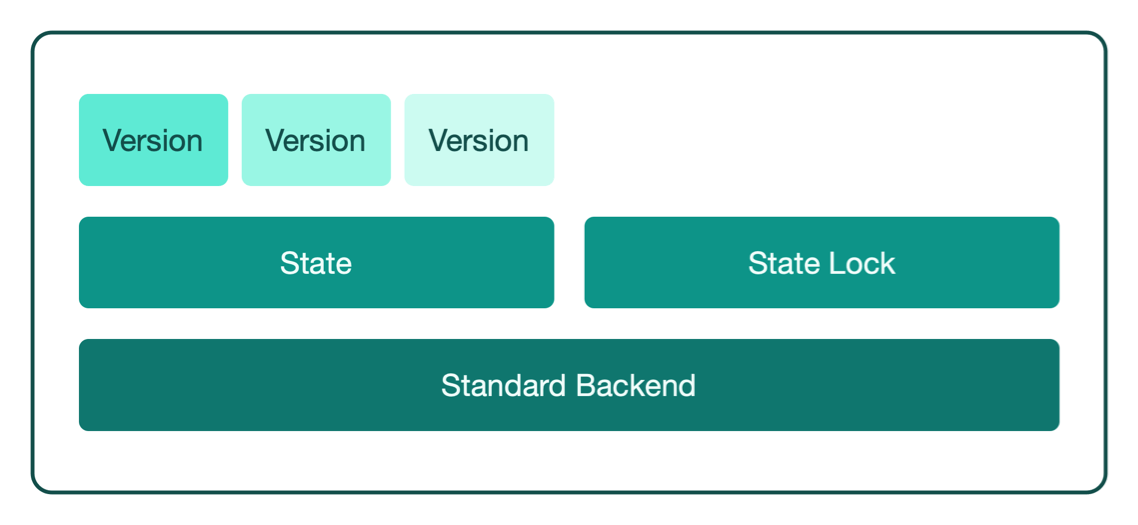
What a standard backend gives you is a place to store state that's reachable from more than one machine. Every engineer can read the state and make changes to the Terraform code. Where versioning is enabled, previous versions of state are kept for that code; this is always a feature of the storage backend itself rather than a component of Terraform.
Standard backends are common and meet most companies' needs, but they push a lot of overhead onto engineers, who are now on the hook for orchestrating the Terraform code and running the other services around it. Sometimes that's exactly what you want. A team might run its own processes, such as testing, alongside each deployment. Using a remote operations backend doesn't stop you from doing that either.
What Do Remote Operations Backends Add on Top?
These used to be called enhanced backends and are now usually just remote. I prefer remote operations backends, because they let you store and version state and also run the Terraform code. For this post I'll stay off product-specific details and stick to what they have in common.
The diagram below shows the components of a remote operations backend, grouped the same way as the standard backend above:
State
- State file(s)
- State versions
- State lock
Operations
- Runs
- Cost estimation
- Policy
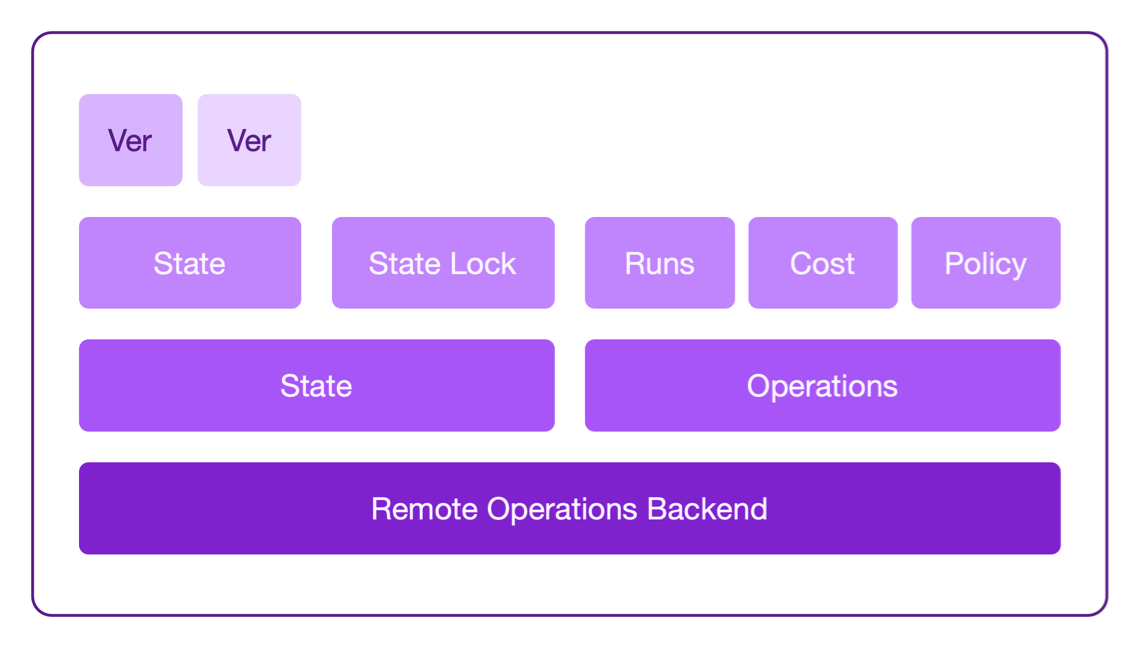
In object-oriented terms, a remote operations backend is a child of the standard backend class. It has the full feature set of the standard one with extra goodies bolted on top. The three main benefits are:
- Runs (executions or orchestration)
- Cost estimation
- Policy enforcement and audit
Runs
These are the executions of the Terraform code, triggered either on checkin to the repository or by some other product-specific means. A run is also what wraps the other benefits of the remote operations backend, which we'll get to shortly.
Cost Estimation
Once the code has been planned, the remote operations backend also runs a cost estimation (where enabled). It tells the engineer the potential cost of either the entire environment or just the changes coming in with the latest commits. That's handy, because engineers see the business cost of deploying resources to an organization's cloud before they do it. It's no longer an I didn't know situation.
Policy
Next comes the policy phase, where any policies the engineers have defined get run. This is how we restrict what gets deployed into cloud environments and how. It can go as far as controlling how a resource is configured or even named. That matters a lot in larger, regulated environments where security operations have to enforce specific controls. It also gives you evidence when an auditor wants proof that a given control is being followed.
You can write policy with Sentinel from HashiCorp or with OPA, which is part of the CNCF. Both give you granular control over the resources your Terraform code is creating. Scalr supports OPA; Sentinel is the HashiCorp-proprietary alternative used by Terraform Cloud.
Policy can also be as mundane as making sure resources carry the correct tags.
So Which Backend Should You Choose?
I'd point you at remote operations backends first, whether you're new to Terraform or already deep down the rabbit hole. If your organization can afford the paid tiers, or you come in under the free tier that most products offer, it's a good place to start. You get all the features above, and you barely have to think about state management. The standard backend is perfectly fine too, and plenty of teams use it. It can feel like it gives you more flexibility. Even so, for most people I think the remote operations backend wins: you pick up a lot of features and cut down your operations overhead.
You can follow Brendan @BrendanLiamT on Twitter.
Frequently asked questions
What is a standard Terraform backend?
A standard backend is usually cloud-specific storage, like an S3 bucket or Azure blob storage, that holds state files, state versions, and a state lock. It gives every engineer a shared place to read state, but it only stores state. Engineers are still responsible for orchestrating Terraform runs and any surrounding processes themselves.
What does a remote operations backend add on top of state storage?
Remote operations backends like Scalr and Terraform Cloud store and version state like a standard backend, and also run the Terraform code. The three main additions are runs (executions triggered on repository checkin or other means), cost estimation, and policy enforcement with audit evidence.
How does cost estimation work in a remote operations backend?
After the code has been planned, the backend runs a cost estimation where it is enabled. It shows the engineer the potential cost of the whole environment or just the changes in the latest commits, so the business cost of a deployment is visible before anything is applied.
Should I choose a remote operations backend or a standard backend?
For most teams, a remote operations backend is the better starting point, whether via a paid tier or the free tier most products offer. You get run orchestration, cost estimation, and policy enforcement, and barely have to think about state management. Standard backends work fine too and plenty of teams use them, but they leave more operations overhead on the engineers.
About the author

solutions engineer at Scalr
Brendan Thompson is a solutions engineer at Scalr, specializing in Terraform and cloud infrastructure.
Part of this guide
19 sheets
Terraform State & Backends: The Complete Guide
- How to Update State in a Remote Backend
- HashiCorp GPG Key Expired: Fixing Terraform Download Errors
- Terraform State Files Best Practices
- Using the AWS S3 Backend Block in Terraform
- Using the AzureRM Backend Block in Terraform
- Using the GCS Backend Block in Terraform
- Dynamic Backend Blocks with OpenTofu
- How to Share Terraform State
- Scalr Terraform State Management: Features and Functionality
- A beginner's guide to the terraform init command
- Understanding OpenTofu Remote Backends
- Updating Terraform State, with Great Power comes Great Responsibility
- How To Use Terraform Remote Backends
- Get Started With Scalr & Terraform CLI on AWS
- Get Started With Scalr & Terraform CLI on Azure
- Get Started With Scalr & Terraform CLI on GCP
- How To: Migrate Terraform State Into Scalr