

Article · part of a guide
Get Started With Scalr & Terraform CLI on GCP
The basics of using Scalr as a remote backend for Terraform with Google Cloud Platform, from linking credentials to deploying a VM.

Key takeaways
- This tutorial shows how to use Scalr as a remote backend for Terraform to deploy a virtual machine on Google Cloud Platform with the Terraform CLI.
- Setup involves linking GCP credentials to Scalr via a service account JSON key or OIDC workload identity federation, then generating a Scalr API token.
- The Scalr remote backend takes your environment name or Environment ID (starting with env-) in the organization field, the ID being required if the name contains a space, and the Scalr token is appended to the Terraform CLI config file.
- Beyond the CLI, Scalr also supports provisioning through VCS integration with GitHub, GitLab, and Bitbucket, the Scalr API, and the Scalr UI.
This tutorial covers the basics of using Scalr as a remote backend for Terraform. Scalr is a Terraform collaboration tool that gives you a centralized runtime environment, state file storage and locking, policy enforcement with the Open Policy Agent, and role-based access controls.
In a couple of minutes you'll have deployed a virtual machine on Google Compute Engine with Terraform and Scalr. We use a virtual machine as the example here, but Scalr can deploy any resource that Terraform can.
What Do You Need Before You Start?
How Do You Link a GCP Service Account to Scalr?
First you need to give Scalr access to your GCP account. The easiest way is to create a Service Account access key in your project and upload the JSON file to Scalr. If you're not sure how to do that, click here. You can also use whatever process you already have set up for Terraform: Hashicorp Vault, environment variables, …
Click on Account in the bottom left corner and go to the account level.
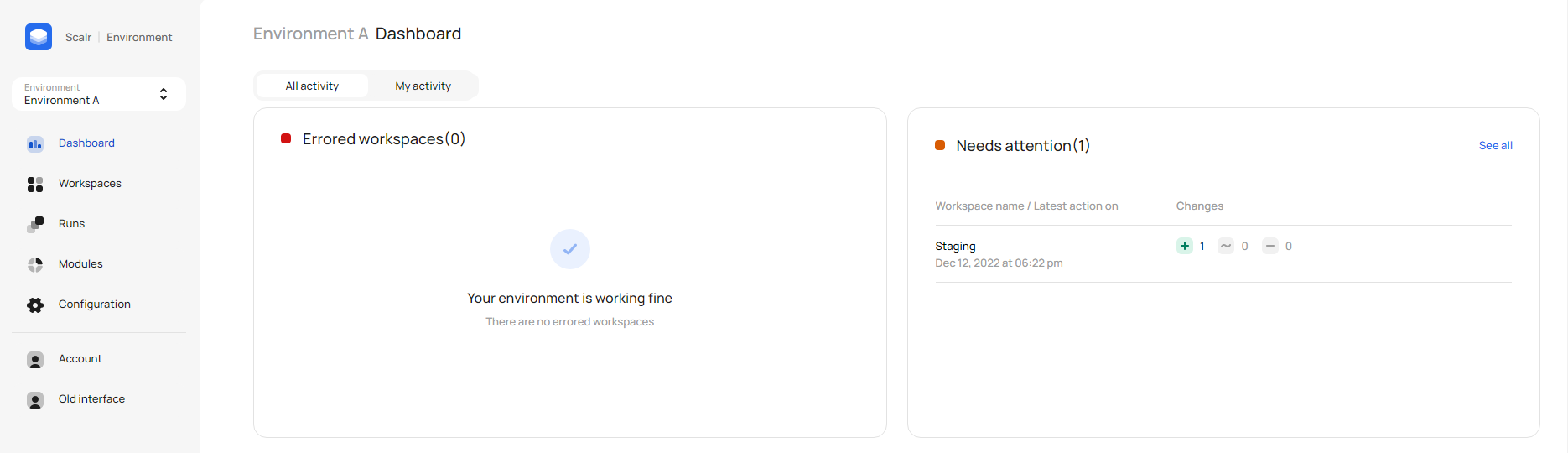
Note: The account level is used for admin tasks - adding cloud credentials, connecting vcs providers, managing users and teams, … The environment level is used to manage workspaces. You can read more on this here.
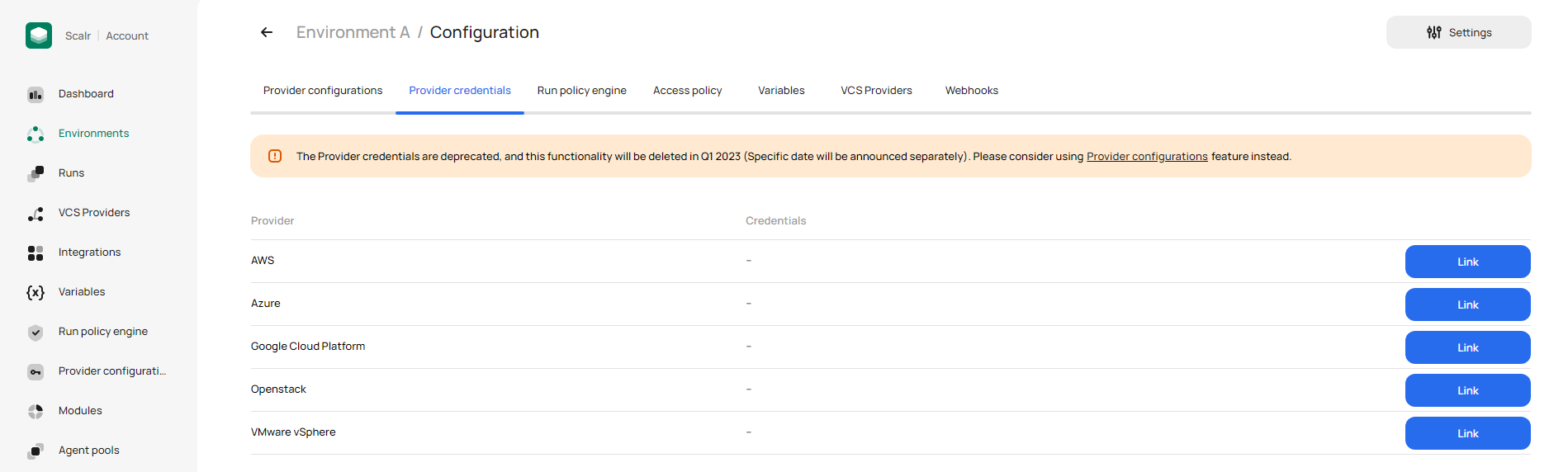
Click on Provider Configurations from the account dashboard. Click on Create Configuration and select Google Cloud Platform. Enter a name and upload the JSON key file for the GCP service account you created above. (As an alternative to a long-lived JSON key, you can configure OIDC workload identity federation so Scalr authenticates to GCP with short-lived federated tokens.) Click save.
How Do You Get Your API Token From Scalr?
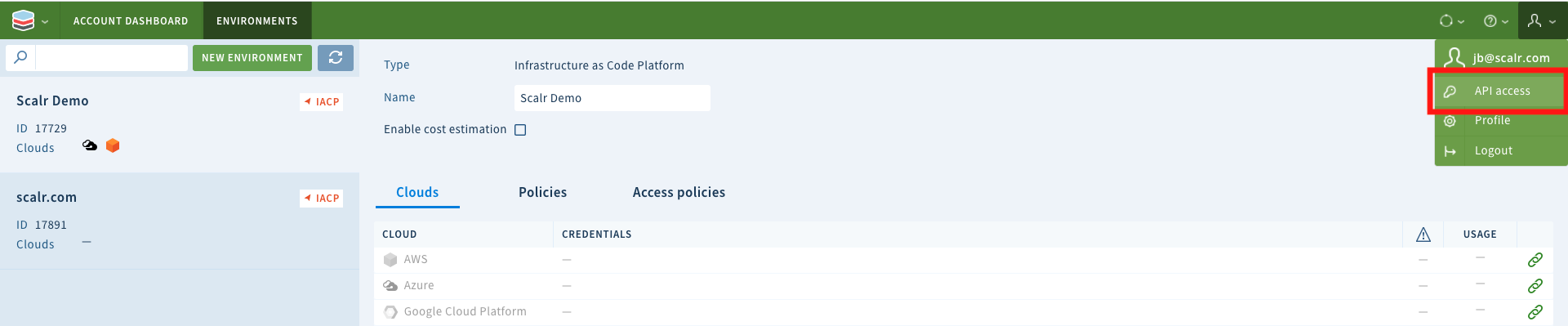
Click on the profile icon on the top right corner of the screen. Click on API access. Click on Generate API Token and save your token.
Where Do You Find Your Environment ID in Scalr?
Go back to the environment scope and copy your Environment ID (it starts with env-) from the dashboard. The Scalr remote backend uses this value in the organization field of your Terraform configuration.
Run the Get Started Script or use your own Terraform files
For this step you can use your own Terraform code or the starter main.tf file we built for this tutorial.
If you have a UNIX-based computer and want to use our starter code, open your terminal and run the following script:
bash <(curl https://raw.githubusercontent.com/jeanbaptistebeck/scalr-get-started-gcp/main/scalr-get-started-gcp.sh)It asks for the Scalr account name you chose when creating your account, the Scalr token you retrieved earlier and a workspace name of your choice. The script creates a main.tf file that deploys a virtual machine. It also appends your Scalr token to your ~/.terraformrc file so that the Terraform CLI can talk to your Scalr account.
If you're using your own Terraform files, append the Scalr token to the CLI configuration file.
- Windows: terraform.rc in %APPDATA% directory
- Unix/Linux/Mac : ~/.terraformrc
credentials "my-account.scalr.io" {
  token = "<user-token>"
}
How Do You Provision the Virtual Machine?
Run terraform apply to provision the instance. Check the run in the Scalr UI, then confirm in your GCP console that the instance has been deployed.
How Do You Destroy the Virtual Machine When You're Done?
Run terraform destroy from the terminal to remove the instance we just launched.
What Else Can Scalr Do Beyond the Terraform CLI?
You've now deployed an instance on GCP using Scalr and the Terraform CLI. The CLI is one of several ways in: you can also provision resources through VCS integration (GitHub, Gitlab, Bitbucket), the Scalr API and the Scalr UI.
A good next step is to invite your team and connect a VCS provider. Current plans are on the pricing page.
Using another cloud provider? Check out Get Started With Scalr on AWS or Get Started With Scalr & Terraform CLI on Azure.
Frequently asked questions
How do you use Scalr as a remote backend for Terraform on GCP?
Link your GCP credentials to Scalr through a provider configuration, generate a Scalr API token, and add the token to your Terraform CLI config file. Point the remote backend at your Scalr account with your Environment ID in the organization field, then run terraform apply to provision resources like a Google Compute Engine virtual machine.
How do you link a GCP service account to Scalr?
Go to the account level in Scalr, open Provider Configurations, create a configuration for Google Cloud Platform, and upload the JSON key file for your GCP service account. As an alternative to a long-lived JSON key, you can configure OIDC workload identity federation so Scalr authenticates with short-lived federated tokens.
Where do you find your Environment ID in Scalr?
Go to the environment scope in the Scalr UI and copy the Environment ID from the dashboard; it starts with env-. The Scalr remote backend uses this value in the organization field of your Terraform configuration.
Can you use Scalr without the Terraform CLI?
Yes. Besides the CLI, Scalr can provision resources through VCS integration with GitHub, GitLab, and Bitbucket, through the Scalr API, and through the Scalr UI.
About the author

director of platform engineering at Scalr
Ryan Fee is the director of platform engineering at Scalr, with over 15 years of experience improving infrastructure experiences at companies large and small.
Part of this guide
19 sheets
Terraform State & Backends: The Complete Guide
- How to Update State in a Remote Backend
- HashiCorp GPG Key Expired: Fixing Terraform Download Errors
- Terraform State Files Best Practices
- Using the AWS S3 Backend Block in Terraform
- Using the AzureRM Backend Block in Terraform
- Using the GCS Backend Block in Terraform
- Dynamic Backend Blocks with OpenTofu
- How to Share Terraform State
- Scalr Terraform State Management: Features and Functionality
- A beginner's guide to the terraform init command
- Understanding OpenTofu Remote Backends
- Updating Terraform State, with Great Power comes Great Responsibility
- Why Use A Remote Operations Backend Over A Standard Backend
- How To Use Terraform Remote Backends
- Get Started With Scalr & Terraform CLI on AWS
- Get Started With Scalr & Terraform CLI on Azure
- How To: Migrate Terraform State Into Scalr