

Article · part of a guide
Spacelift Alternatives: Spacelift vs Scalr, Terraform Cloud, env0, and Atlantis (2026)SPACELIFT OR NOT SPACELIFT? CAVEMAN COMPARE BIG TOOLS (2026)
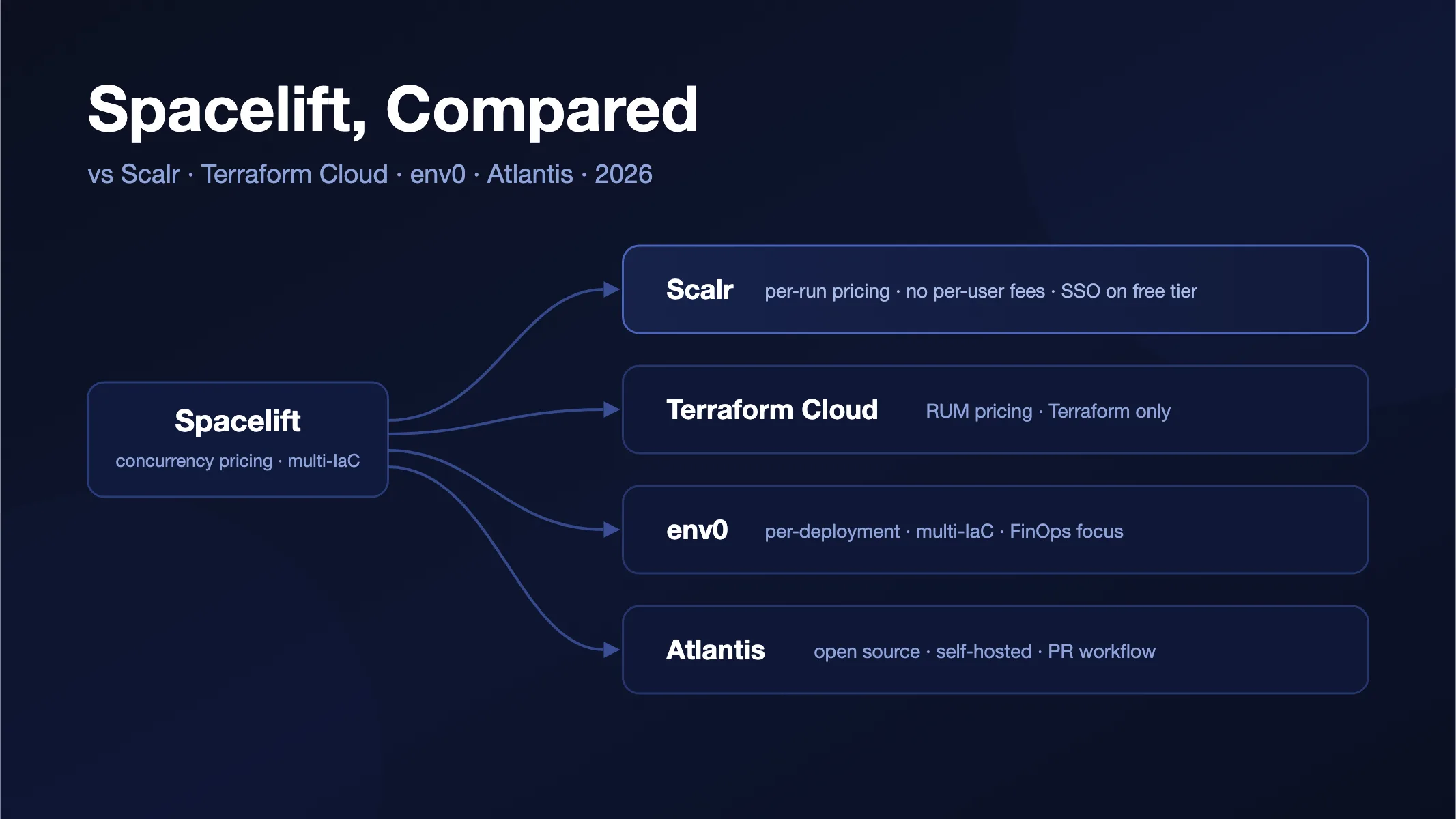
A Spacelift-anchored comparison guide for 2026: how Spacelift's concurrency-based pricing and tier gates work, how it compares to Scalr, Terraform Cloud, env0, and Atlantis, and decision rules for choosing between them.Caveman look hard at Spacelift, Scalr, Terraform Cloud, env0, and Atlantis. Who charge what shells, who gate what features, which tribe should pick which. No tricks, just grunts.
Key takeaways
- Spacelift's main strength is multi-IaC orchestration: one platform for Terraform, OpenTofu, Pulumi, CloudFormation, Kubernetes, and Ansible, with a flexible Rego-based policy engine. If you run several of those tools in production, it deserves to be on your shortlist.
- Spacelift prices by concurrency (parallel run slots called workers), not by usage. As of June 2026, it keeps a free plan (2 users, 1 public worker, no time limit), but the cheap ~$399/month Starter tier is gone. The entry paid tier is now Starter+ at $20,000/year for unlimited users, which is where the policy engine and drift detection begin. SAML SSO and audit trails are gated to Enterprise, and self-hosting to Enterprise+.
- Scalr is the strongest Spacelift alternative for Terraform/OpenTofu-only teams: per-run pricing with no per-user fees, SSO/SAML, full RBAC, OPA policies, and free drift detection on the standard plan (free up to 50 runs/month), and a Terraform Cloud-style remote backend workflow rather than a GitOps stack model.
- Because both Spacelift and Scalr use Open Policy Agent, Rego policies are largely portable between them. Switching platforms doesn't mean rewriting your policy library from scratch.
- The decision rule that resolves most evaluations: count the IaC tools you actually run remotely. One (Terraform or OpenTofu) → Scalr or Terraform Cloud. Several → Spacelift or env0. Zero budget and one team → Atlantis.
Somewhere in your evaluation doc there's a row that says "Spacelift." Maybe a teammate used it at their last company, or you searched for Terraform Cloud alternatives after the free tier reached end-of-life, or you're already on Spacelift and the renewal quote reopened the question. Either way, you need a straight answer on how Spacelift compares to everything else in the category.
Spacelift is the strongest option when you orchestrate multiple IaC tools (Terraform plus Pulumi, CloudFormation, Kubernetes, or Ansible) through one platform. Scalr is the strongest option when you run Terraform or OpenTofu only and want per-run pricing with the core governance stack (SSO, RBAC, OPA policies, and free drift detection) on every tier. Terraform Cloud is the incumbent with the tightest pure-Terraform integration and a resources-under-management pricing model that grows with inventory. env0 is the other multi-IaC platform, with a FinOps slant. Atlantis is the free, self-hosted option for a single team with ops capacity. The rest of this guide is the reasoning, pairing by pairing.
One disclosure up front: we build Scalr, one of the alternatives discussed here. Several sections below point you at Spacelift where it's the better fit.
What is Spacelift, and what is it genuinely good at?
Spacelift is an infrastructure orchestration platform built around stacks, units that connect a VCS repository to a runtime environment. What sets it apart is breadth: a stack can run Terraform, OpenTofu, Terragrunt, Pulumi, CloudFormation, Kubernetes manifests, or Ansible playbooks. If you're a platform team wrangling a mixed estate, that's the headline feature, and env0 is the only other platform on this page that comes close.
Three other capabilities stand out:
- A flexible Rego policy engine. Spacelift applies Open Policy Agent policies at multiple decision points: push policies (what triggers runs), plan policies (what changes are allowed), approval policies (who must sign off), and trigger policies (what runs after what). It's a powerful customization layer.
- Worker pools and custom runner images. Runs execute on workers, Spacelift-hosted (public) or self-hosted (private), using Docker images you can customize. Private workers let runs execute inside your network.
- Stack dependencies and blueprints. Stacks can trigger one another and pass outputs downstream, and blueprints (a Business-tier feature) template stack creation for self-service.
The workflow is GitOps-centric: changes flow through VCS events into stack runs. That's a strength if GitOps is how you operate, and a real adjustment if your engineers live in the terraform plan / terraform apply CLI loop against a remote backend.
How does Spacelift pricing work in 2026?
Spacelift is concurrency-metered: you buy a number of workers, and a worker "processes a single run at a time", so by Spacelift's own docs "your number of workers is equal to your maximum concurrency" (docs, September 2026). As of June 2026, the published tiers are:
| Tier | Price (as of June 2026) | Users | Workers | Notable gates |
|---|---|---|---|---|
| Free | $0, no time limit | 2 | 1 public | No policy engine, no module registry, no drift detection, no private workers |
| Starter+ | $20,000/year | Unlimited | 2 public + 1–2 private | Entry paid tier; adds the policy engine, drift detection, and private provider registry |
| Business | Annual, pricing on request | Unlimited | 3 private | Adds blueprints, targeted replans, advanced scheduling |
| Enterprise | Annual, pricing on request | Unlimited | 5–30 private | Adds SAML 2.0 SSO and audit trail |
| Enterprise+ | Annual, pricing on request | Unlimited | 12–30 private | Adds self-hosting, FedRAMP, airgapped deployment |
The older, cheaper Starter tier (~$399/month for 10 users) is no longer listed; the entry paid step is now the $20,000/year Starter+ annual subscription.
Two structural things to understand before you model costs:
Concurrency pricing bills for peak capacity, not usage. The invoice is predictable (a fixed number of slots) but the capacity question isn't. When more runs queue than you have workers, runs wait. The queue is longest exactly when waiting hurts most: incident response, release windows, a refactor that touches forty stacks. Your options at that moment are to wait or to buy more slots, and the slots you buy for peak load sit idle the rest of the month. No slot count gets this right. Size for the peak and you overpay most of the month; size for the average and you're throttled during incidents and releases. We've written a deeper analysis of this trade-off in our guide to evaluating IaC platform pricing models.
The features compliance teams ask about sit at the top of the ladder. Drift detection and the policy engine start at Starter+, the $20,000/year entry paid tier. SAML SSO and the audit trail are gated to Enterprise, and self-hosted deployment to Enterprise+. If your security review requires SSO and exportable audit logs, as most do, you're looking at the Enterprise tier, well above the $20,000/year entry price.
Spacelift vs Terraform Cloud: which should you choose?
This is the most-searched pairing. The two platforms charge for different things and run different things.
What they run. Terraform Cloud (HCP Terraform) runs Terraform, full stop: no OpenTofu, no Terragrunt, no Pulumi. Spacelift runs all of those plus CloudFormation, Kubernetes, and Ansible. If multi-IaC is your reality, the comparison ends here in Spacelift's favor.
What they charge for. Terraform Cloud uses resources-under-management (RUM) pricing: as of early 2026, $0.10 (Essentials), $0.47 (Standard), or $0.99 (Premium) per resource per month. The bill tracks the size of your state files, whether or not anything changes. Discounts don't change that shape: customers who migrated from Terraform Cloud to Scalr report having been offered an average discount of 18% (median 12%) on their TFC contracts in a Q4 2025 sample, a percentage off a bill that still grows with inventory. Spacelift's bill tracks how many parallel run slots you buy. Neither model tracks usage: RUM punishes large stable estates, concurrency pricing punishes bursty workloads. Model both against your actual run volume and resource count.
Workflow. Terraform Cloud is a remote operations backend, the CLI workflow your engineers already know. Spacelift's GitOps stack model is a bigger change to adopt.
For a section-by-section breakdown of state management, drift detection, policy engines, and pricing mechanics across these two, see our dedicated Terraform Cloud vs Spacelift comparison.
Is moving from Terraform Cloud to Spacelift a re-platforming?
Yes, by Spacelift's own documentation. As of September 2026 its state-management docs say to "not specify any Terraform backend whatsoever" and warn that init "will keep failing until you remove it". Its migration tool, liftoff, turns Terraform Cloud organizations and projects into spaces and workspaces into stacks, and records teams, agent pools, policies, and run tasks as audit-only data rather than recreating them. A drop-in keeps the cloud/remote backend, CLI, and API and moves state, variables, and workspaces.
So the platforms on this page sort into two buckets before you compare features. Drop-in replacements for Terraform Cloud: Scalr, Terraform Enterprise, and the open-source Terrakube. Re-platforming: Spacelift and Atlantis. env0 sits between them; its cloud-backend remote apply is a per-environment option that env0's own docs, as of August 2026, say is not recommended for production. The bucket doesn't decide the winner. Spacelift's re-platforming buys multi-IaC stacks, stack dependencies, and self-hosting on Enterprise+, none of which a pure-play Terraform and OpenTofu platform like Scalr offers (Scalr's control plane is SaaS-only, with self-hosted agents for runs). What it costs is the CLI-and-API workflow your pipelines already use.
Spacelift vs Scalr: what's the difference?
These two get shortlisted together all the time, and the difference comes down to scope and model.
Scope. Spacelift orchestrates many IaC tools. Scalr specializes in Terraform, OpenTofu, and Terragrunt, including Terragrunt run-all orchestration with dependency resolution, which is rare in the category. If you run Pulumi or CloudFormation through the same control plane, Spacelift wins this axis outright. If you run Terraform/OpenTofu only, Spacelift's breadth is complexity you pay for but don't use.
Workflow model. Scalr operates as a remote operations backend, the same model as Terraform Cloud: runs execute remotely, state lives in the backend, and terraform plan works unchanged from any engineer's terminal. Scalr also supports Atlantis-style PR commands (/scalr plan, /scalr apply) for teams that prefer the PR-comment workflow, and both orderings (apply-before-merge and merge-before-apply) work natively, including through the PR commands. Spacelift is stack- and GitOps-centric. Coming from Terraform Cloud, Scalr is a drop-in replacement; Spacelift is a re-platforming.
Pricing model. Scalr charges per run, with no per-user fees and no charge for concurrency: the standard plan is free up to 50 runs/month, and paid usage is prepaid run packages with volume discounts and a $0.99/run flex rate beyond them. There are no parallel-slot fees to provision for peak load: bursty weeks cost more, idle weeks cost less. Spacelift charges for concurrency regardless of how much you run.
Feature gates. Both platforms gate some features by tier; the practical difference is where the gates sit. Scalr's standard per-run plan, free up to 50 runs/month, includes SAML SSO, custom RBAC roles built from 147 granular permissions, OPA policy enforcement, drift detection (free, and it doesn't consume billable runs), unlimited users, and no charge for concurrency. On Spacelift, the policy engine and drift detection begin at Starter+, the $20,000/year entry paid tier, and SAML SSO with the audit trail are reserved for Enterprise; the free plan is limited to 2 users and excludes the policy engine. Both platforms reserve some capabilities for their enterprise tiers. On Scalr, the Enterprise plan adds audit logs, SCIM provisioning, customer-managed encryption keys, and Storage Profiles, which keep all run artifacts (state files, configuration versions, plan files, and logs) in your own S3, GCS, or Azure bucket for data residency. But the governance features a mid-size team needs on day one sit on Scalr's standard tier and on Spacelift's most expensive one.
Governance depth for Terraform specifically. Both platforms use OPA. Scalr evaluates policies pre-plan and post-plan with three enforcement levels (advisory, soft-mandatory, hard-mandatory), and a run rejected pre-plan doesn't consume a billable run. A cost-control policy looks like this in Scalr:
package scalr.policy

deny[msg] {
    input.tfrun.cost_estimate.delta_monthly_cost > 500
    not input.tfrun.workspace.tags["high-cost-approved"]
    msg := sprintf("Monthly cost increase of $%.2f exceeds the $500 limit.", [input.tfrun.cost_estimate.delta_monthly_cost])
}
Because Spacelift's plan policies are also Rego, the logic, if not the input schema, is portable in both directions. Whichever platform you choose, your policy investment survives; switching means adjusting input references, not rewriting your policy library.
State management. Scalr provides a managed state backend on every tier, and, like Terraform Cloud, you can also keep your own remote backend (your own S3, GCS, or Azure bucket) on any plan and have Scalr run plan and apply against it. For teams that want Scalr's managed workflow but need every artifact to stay in their own cloud, the Enterprise plan adds Storage Profiles, which route all run artifacts (state files, configuration versions, plan files, and logs) into your bucket for data residency. Both platforms offer self-hosted execution (Spacelift private workers from Starter+; Scalr self-hosted agents), which we compare in detail in our self-hosted options guide.
Fleet visibility. A Scalr workspace runs Terraform or OpenTofu and nothing else, so every workspace shares one state schema. That lets Scalr report against Terraform's own objects across the whole estate. The Resources report aggregates all resources across all state files into a single dashboard, alongside Modules, Providers, Versions, Drift, and Stale Workspaces reports. Scalr also surfaces queued-runs and pending-approvals metrics and streams events to Datadog. A platform that spans several IaC tool types reports more generically across them, the natural tradeoff for supporting that breadth. The payoff of the single-schema rollup is concrete: a platform team can see a struggling team and step in to raise a quota, fix a policy, or unblock a run.
Multi-IaC estate → Spacelift. Terraform/OpenTofu estate → Scalr gives you deeper governance per dollar on the standard plan, a workflow your team already knows, and cleaner observability. A control plane that runs only Terraform and OpenTofu has less cardinality and less noise in run history, drift reports, and dashboards than one orchestrating six tool types.
Spacelift vs env0: how do the two multi-IaC platforms compare?
If you need multi-IaC support, env0 is the other serious candidate. Both run Terraform, OpenTofu, Terragrunt, Pulumi, and CloudFormation; both use OPA for policy.
The differences worth testing in a proof of concept:
- Pricing metric. env0 (rebranding to "env zero") prices by plan tier, anchored on active environments. As of August 2026 it has a free-forever tier (250 runs/month, up to 30 active environments, unlimited users) and two paid tiers, Cloud Navigator and Cloud Pilot, both custom-quoted and billed per successful apply or environment. Spacelift anchors on concurrency instead. Neither bill tracks usage directly, so model both against your environment count and your peak parallelism. As with Spacelift, check which governance features sit on which tier before assuming the entry price is your price.
- FinOps orientation. env0's cost tracking, budget controls, and per-environment cost attribution are more developed than Spacelift's cost estimation. If your FinOps team has a seat in the evaluation, this is env0's strongest card. Its built-in dashboards lean activity- and cost-centric, though; the IaC-usage analytics (module usage, provider versions, resource rollups) sit behind Cloud Analyst, a paid AI add-on, rather than in the standard fleet reports.
- Workflow customization. Spacelift's policy surface (push, plan, approval, trigger policies) and custom runner images give platform teams more orchestration control. Complex multi-stack dependency graphs are where Spacelift is strongest.
Neither is a remote operations backend. Coming from Terraform Cloud, both are workflow changes, unlike Scalr.
Spacelift vs Atlantis: managed platform or self-hosted open source?
Atlantis is free, open source, and self-hosted: it listens for pull request comments (atlantis plan, atlantis apply) and runs Terraform in response. For a single team that wants plan output in PRs and has someone to operate the server, it's the right answer: no license cost, full control.
The comparison with Spacelift is a comparison of what you're not getting and would have to build:
- Operations. Atlantis needs hosting, scaling, patching, and upgrades, typically 0.5–1 FTE as usage grows. That FTE is also a key-person risk: when the engineer who runs your Atlantis server departs, the undocumented webhook configuration, patching cadence, and recovery procedures leave with them. Spacelift (and every managed platform here) makes that someone else's job. Note that self-hosting Spacelift itself is an Enterprise-tier option, so "Atlantis-style control with Spacelift features" is its most expensive configuration.
- Governance. Atlantis has no native policy enforcement, RBAC, audit trail, or drift detection; teams bolt on Conftest or Checkov and accept the gaps. Spacelift has all of these (on the tiers noted above). The gaps become blockers at predictable moments: the first compliance audit, the fifth team, the first incident caused by an unreviewed apply.
- Workflow. Atlantis is PR-comment-only. If your teams like working that way, Scalr supports the same commands (
/scalr plan,/scalr apply) on top of a full governance platform, so outgrowing Atlantis doesn't mean abandoning the workflow.
When is Spacelift the right choice?
Cases where we'd point you at Spacelift over the alternatives, including ours:
- You run two or more IaC tools in production (Terraform plus Pulumi, CloudFormation, Kubernetes, or Ansible) and want one control plane, one policy engine, and one audit surface across them.
- You have cross-tool dependency chains: a Terraform stack that provisions a cluster, a Kubernetes stack that deploys onto it, an Ansible stack that configures hosts, and you want output passing and ordered triggering between them.
- You want many policy decision points (push-time, run-trigger, and notification policies on top of plan-time checks) where Spacelift's Rego surface reaches stages Scalr's pre- and post-plan evaluation doesn't.
- You're already operating GitOps-only and the stack model matches how your organization thinks.
When should you choose a Spacelift alternative?
- You run only Terraform or OpenTofu. You'd be paying for breadth you don't use, with the governance features you do need gated at Starter+ and Enterprise. A specialized platform like Scalr provides the governance stack (OPA pre/post-plan, 147 RBAC permissions, SSO, free drift detection) on its standard plan, priced per run. Our guide to selecting an IaC management platform covers the full decision framework.
- Your workload is bursty. Concurrency pricing means choosing between queued runs at peak and idle slots off-peak. Per-run or per-deployment pricing (Scalr, env0) tracks usage instead.
- You need SSO and drift detection on a mid-size budget. On Spacelift, drift detection starts at Starter+ and SAML SSO is Enterprise-tier; on Scalr both are on the free tier. (Audit logs are an enterprise-tier feature on both platforms.)
- You want the Terraform Cloud workflow without Terraform Cloud. Only a remote operations backend preserves the plain CLI experience. That's Scalr, and the migration tooling automates workspace, variable, and state transfer. Teams with 500+ workspaces have migrated in under a week. Scalr offers free migration periods to some teams leaving Terraform Cloud. Ask when you talk to us.
- You have one team and no budget. Run Atlantis, with eyes open about the FTE cost and the governance gaps you'll hit at scale.
Which platform should you choose?
Count the IaC tools you actually run through a control plane. Several → Spacelift (orchestration depth) or env0 (FinOps depth). One, and it's Terraform or OpenTofu → Scalr if you want usage-based pricing and ungated governance, Terraform Cloud if you want the HashiCorp-native experience and can live with RUM pricing. One team, zero budget → Atlantis until the audit.
If you land in the Terraform/OpenTofu-only column, the evaluation is cheap to run: Scalr's free tier includes 50 runs per month with the core feature set enabled (OPA policies, custom RBAC, SSO, drift detection, no charge for concurrency) so you can point a real environment at it and judge against your actual workloads before committing anything.
Somewhere on tribe comparison tablet there is row that say "Spacelift" — maybe tribe member used it in old tribe, maybe caveman searched for Terraform Cloud alternatives after free tier died, maybe tribe already on Spacelift and renewal quote made chief drop club. Whatever reason, caveman need same thing: straight answer on how Spacelift compare to everything else.
Short version first. Spacelift strongest when tribe herd MANY kinds of magic tools — Terraform plus Pulumi, CloudFormation, Kubernetes, or Ansible — through one platform. Scalr strongest when tribe run only Terraform or OpenTofu and want pay-per-hunt shells with governance features on every tier. Terraform Cloud is old chief with tightest pure-Terraform fit, but bill grow with how many rocks tribe own. env0 is other many-tool platform, watch shells closely (FinOps). Atlantis is free self-hosted choice for one team with ops muscle. Rest of tablet is the reasoning, fight by fight.
One thing caveman say up front: caveman tribe BUILD Scalr, one of alternatives on this tablet. Where Spacelift is better pick, caveman say so — several such cases below. Honest grunt only.
WHAT IS SPACELIFT? WHAT IT GOOD AT?
Spacelift is orchestration platform built around stacks — each stack connect code cave (VCS repository) to place where magic run. Big thing about Spacelift: it run MANY tool types. One stack can run Terraform, OpenTofu, Terragrunt, Pulumi, CloudFormation, Kubernetes scrolls, or Ansible playbooks. For platform tribe herding many different beasts, that is headline power, and nothing else in category match it.
Three more powers worth grunt:
- Bendy Rego policy magic. Spacelift apply Open Policy Agent rules at many decision points — push policies (what start hunts), plan policies (what changes allowed), approval policies (which elder must nod), trigger policies (what hunt follow what hunt). Genuinely strong customization layer.
- Worker pools and custom runner images. Hunts run on workers — Spacelift-hosted (public) or tribe-hosted (private) — using Docker images tribe can shape. Private workers let hunts run inside tribe own cave.
- Stack dependencies and blueprints. Stacks can poke each other awake and pass outputs downstream. Blueprints (Business-tier power) template stack-making for self-service.
Workflow is GitOps-centric: changes flow from code cave events into stack hunts. Strength if GitOps is how tribe live. Real adjustment if tribe engineers live in terraform plan / terraform apply grunt loop against remote backend.
HOW SPACELIFT SHELLS WORK IN 2026?
Spacelift charge by concurrency: tribe buy number of workers, each worker is one parallel hunt slot. As of June 2026, published tiers look like this:
| Tier | Shells (as of June 2026) | Users | Workers | Big gates |
|---|---|---|---|---|
| Free | $0 | 2 | 1 public | No policy magic, no module registry |
| Starter | $399/month | 10 | 2 public | No drift watching, no private workers, no SAML |
| Starter+ | Annual, ask for price | No limit | +1 private | Add drift watching |
| Business | Annual, ask for price | No limit | 3+ private | Add blueprints, targeted replans, private provider registry |
| Enterprise | Annual, ask for price | No limit | 5+ private | Add SAML 2.0 SSO, audit trail, self-host option |
Two structure things caveman must understand before counting shells:
Concurrency pricing charge for PEAK capacity, not usage. Invoice predictable — fixed number of slots — but capacity question not predictable. When more hunts queue than tribe have workers, hunts WAIT. Queue longest exactly when waiting hurt most: cave on fire, big release day, refactor touching forty stacks. Tribe options at that moment: wait, or buy more slots. And slots bought for peak sit idle rest of moon. No slot count get this right: size for peak, overpay most of moon; size for average, get throttled at worst moments. Caveman wrote deeper thinking on this in guide to judging IaC platform pricing.
Features compliance elders ask about sit at TOP of ladder. Drift watching start at Starter+. SAML SSO, audit trail, and self-hosting are Enterprise-only. If security review demand SSO and exportable audit logs — most do — then $399 Starter price is NOT price tribe will pay.
SPACELIFT VS TERRAFORM CLOUD: WHICH CAVEMAN PICK?
Most-searched fight. Cleanest framing: two platforms charge for different things and run different things.
What they run. Terraform Cloud (HCP Terraform) run Terraform, full stop — no OpenTofu, no Terragrunt, no Pulumi. Spacelift run all those plus CloudFormation, Kubernetes, and Ansible. If many-tool life is tribe reality, fight end here, Spacelift win.
What they charge for. Terraform Cloud use resources-under-management (RUM) shells — as of early 2026, $0.10 (Essentials), $0.47 (Standard), or $0.99 (Premium) per rock per month. Bill track size of tribe rock pile, even when nothing change. Discounts no change shape of bill: tribes who moved from Terraform Cloud to Scalr report average discount offer of 18% (median 12%) on TFC contracts in Q4 2025 sample — percent off bill that still grow with rock pile. Spacelift bill track how many parallel hunt slots tribe buy. NEITHER model track usage: RUM punish big stable caves, concurrency punish bursty tribes. Caveman must model both against real hunt volume and real rock count.
Workflow. Terraform Cloud is remote operations backend — grunt loop engineers already know. Spacelift GitOps stack model is bigger change to adopt.
For section-by-section breakdown of state, drift watching, policy magic, and shell mechanics between these two, see dedicated Terraform Cloud vs Spacelift tablet.
SPACELIFT VS SCALR: WHAT DIFFERENT?
These two get shortlisted together all the time. Difference come down to scope and model.
Scope. Spacelift herd many tool types. Scalr specialize in Terraform, OpenTofu, and Terragrunt — including Terragrunt run-all herding with dependency resolution, rare power in category. Tribe run Pulumi or CloudFormation through same control plane? Spacelift win this axis, no contest. Tribe run only Terraform/OpenTofu? Spacelift breadth is complexity tribe pay for but never use.
Workflow model. Scalr work as remote operations backend, same model as Terraform Cloud: hunts run remotely, state live in backend, terraform plan work unchanged from any engineer rock. Scalr also speak Atlantis-style PR grunts (/scalr plan, /scalr apply) for tribes who like PR-comment way, and both orders — apply-before-merge and merge-before-apply — work natively, including through PR grunts. Spacelift is stack- and GitOps-centric. Tribe coming from Terraform Cloud: Scalr is drop-in swap; Spacelift is re-platforming.
Shell model. Scalr charge per hunt, no per-user shells, no charge for concurrency: standard plan free up to 50 hunts per moon, paid usage is prepaid hunt packages with volume discounts and $0.99/hunt flex rate beyond them. No parallel-slot fees to provision for peak: bursty moons cost more, quiet moons cost less. Spacelift charge for concurrency no matter how much tribe actually hunt.
Feature gates. Both platforms gate some features by tier; practical difference is WHERE gates sit. Scalr standard per-hunt plan — free up to 50 hunts per moon — include SAML SSO, custom RBAC roles built from 147 small permissions, OPA policy enforcement, drift watching (free, and it no eat billable hunts), unlimited users, and no charge for concurrency. On Spacelift, $399/month Starter tier include policy magic but cap users at 10, no drift watching (Starter+), no SAML SSO (Enterprise). Both platforms keep some powers for enterprise tiers — on Scalr that is audit logs, SCIM provisioning, customer-managed keys, and bring-own state storage — but governance features mid-size tribe need on day one sit on Scalr FREE tier and on Spacelift MOST EXPENSIVE one.
Governance depth for Terraform. Both use OPA. Scalr judge policies before plan and after plan with three enforcement levels (advisory, soft-mandatory, hard-mandatory), and hunt rejected pre-plan no eat billable hunt. Cost-control rule look like this in Scalr:
package scalr.policy

deny[msg] {
    input.tfrun.cost_estimate.delta_monthly_cost > 500
    not input.tfrun.workspace.tags["high-cost-approved"]
    msg := sprintf("Monthly cost increase of $%.2f exceeds the $500 limit.", [input.tfrun.cost_estimate.delta_monthly_cost])
}
Spacelift plan policies also Rego, so logic — if not input schema — portable both directions. Whichever platform tribe pick, policy investment survive. Switching mean adjusting input references, not rewriting whole policy library. Good news for careful tribes.
State management. Scalr managed state backend is standard, and Enterprise plan add bring-own storage — state in tribe own S3, GCS, or Azure bucket — matters when data residency law say state never leave tribe account. Both platforms offer self-hosted execution (Spacelift private workers from Starter+; Scalr self-hosted agents). Caveman compare those in detail in self-hosted options tablet.
Summary grunt: many-tool cave → Spacelift. Terraform/OpenTofu cave → Scalr give deeper governance per shell on standard plan, workflow tribe already know, and cleaner watching — control plane that run only Terraform and OpenTofu have less noise in hunt history, drift reports, and dashboards than one herding six tool types.
SPACELIFT VS ENV0: TWO MANY-TOOL PLATFORMS FIGHT
If tribe need many-tool support, env0 is other serious candidate. Both run Terraform, OpenTofu, Terragrunt, Pulumi, and CloudFormation. Both use OPA for policy.
Differences worth testing in proof of concept:
- Shell metric. env0 (rebranding to "env zero") charge by plan tier, anchored on active environments — as of August 2026 free tier give 250 runs per moon and up to 30 active environments with unlimited tribe members, two paid tiers above custom-quoted per successful apply or environment. Spacelift anchor on concurrency instead. Neither bill track usage directly, so model both against tribe environment count and peak parallelism. Like with Spacelift: check which governance features sit on which tier before assuming entry price is tribe price.
- FinOps orientation. env0 cost tracking, budget controls, and per-environment cost attribution more developed than Spacelift cost estimation. If shell-counting elders have seat in evaluation, this is env0 strongest card.
- Workflow customization. Spacelift policy surface (push, plan, approval, trigger policies) and custom runner images give platform tribe more herding control. Complex multi-stack dependency graphs are where Spacelift strongest.
Neither is remote operations backend — tribe coming from Terraform Cloud, both are workflow changes, unlike Scalr.
SPACELIFT VS ATLANTIS: PAY PLATFORM OR FREE CAVE SERVER?
Atlantis free, open source, self-hosted: it listen for pull request grunts (atlantis plan, atlantis apply) and run Terraform in response. For one team that want plan output in PRs and have someone to feed the server, genuinely right answer — no license shells, full control.
Comparison with Spacelift is really comparison of what tribe NOT getting and would have to build:
- Operations. Atlantis need hosting, scaling, patching, upgrades — usually 0.5–1 whole caveman (FTE) as usage grow. That caveman also key-person risk: when engineer who feed Atlantis server leave tribe, undocumented webhook setup, patching rhythm, and recovery rituals leave with them. Spacelift (and every managed platform here) make that someone else problem. Note: self-hosting Spacelift itself is Enterprise-tier option, so "Atlantis-style control with Spacelift powers" is its MOST expensive shape.
- Governance. Atlantis have no native policy enforcement, no RBAC, no audit trail, no drift watching. Tribes bolt on Conftest or Checkov and accept gaps. Spacelift have all these (on tiers noted above). Gaps become blockers at predictable moments: first compliance audit, fifth team, first fire caused by unreviewed apply.
- Workflow. Atlantis is PR-comment-only. If tribe like working that way, Scalr speak same grunts (
/scalr plan,/scalr apply) on top of full governance platform, so outgrowing Atlantis no mean abandoning the workflow.
WHEN SPACELIFT RIGHT PICK?
Cases where caveman point tribe at Spacelift over alternatives, including caveman own:
- Tribe run two or more IaC tools in production — Terraform plus Pulumi, CloudFormation, Kubernetes, or Ansible — and want one control plane, one policy magic, one audit surface across them.
- Tribe have cross-tool dependency chains: Terraform stack make cluster, Kubernetes stack deploy onto it, Ansible stack configure hosts — and tribe want output passing and ordered triggering between them.
- Platform tribe want deep workflow customization — custom runner images, policy hooks at every lifecycle stage — and have engineering muscle to use it.
- Tribe already live GitOps-only and stack model match how tribe think.
WHEN CAVEMAN PICK SOMETHING ELSE?
- Tribe run only Terraform or OpenTofu. Tribe would pay for breadth tribe no use, with governance features tribe DO need gated at Starter+ and Enterprise. Specialized platform like Scalr give governance stack — OPA before and after plan, 147 RBAC permissions, SSO, free drift watching — on standard plan, charged per hunt. Guide to selecting IaC management platform cover full decision framework.
- Tribe workload bursty. Concurrency shells mean choosing between queued hunts at peak and idle slots off-peak. Per-hunt or per-deployment shells (Scalr, env0) track usage instead.
- Tribe need SSO and drift watching on mid-size shell pile. On Spacelift, drift watching start at Starter+ and SAML SSO is Enterprise-tier; on Scalr both on free tier. (Audit logs are enterprise-tier power on BOTH platforms. Caveman say both, caveman honest.)
- Tribe want Terraform Cloud workflow without Terraform Cloud. Only remote operations backend preserve plain grunt-loop experience — that is Scalr, and migration tooling automate workspace, variable, and state moving. Tribes with 500+ workspaces have moved cave in under one week.
- Tribe have one team and zero shells. Run Atlantis, with eyes open about FTE cost and governance gaps tribe will hit at scale.
WHICH ONE CAVEMAN CHOOSE?
Count IaC tools tribe ACTUALLY run through control plane. Several → Spacelift (herding depth) or env0 (FinOps depth). One, and it Terraform or OpenTofu → Scalr if tribe want usage-based shells and ungated governance, Terraform Cloud if tribe want HashiCorp-native experience and can live with RUM shells. One team, zero shells → Atlantis until the audit come.
If tribe land in Terraform/OpenTofu-only column, evaluation cheap to run: Scalr free tier include 50 hunts per moon with core powers enabled — OPA policies, custom RBAC, SSO, drift watching, no charge for concurrency — so tribe can point real cave at it and judge against real workloads before committing any shells. Ugh. Go compare.
Frequently asked questions
What is the best alternative to Spacelift?
It depends on why you're looking. If you run only Terraform or OpenTofu, Scalr is the strongest alternative: per-run pricing instead of concurrency-based, SSO, RBAC, OPA policies, and free drift detection on the standard plan rather than gated at enterprise tiers, and a remote backend workflow that preserves the plain terraform plan/apply CLI experience. If you need multi-IaC support like Spacelift's, env0 is the closest substitute. If license cost is the constraint, self-hosted Atlantis covers PR-based plan/apply automation for a single team.
Is Spacelift better than Terraform Cloud?
They optimize for different things. Spacelift orchestrates many IaC tools (Terraform, OpenTofu, Pulumi, CloudFormation, Kubernetes, Ansible) and prices by concurrency; Terraform Cloud runs only Terraform and prices by resources under management ($0.10–$0.99 per resource per month as of early 2026). Multi-tool shops generally prefer Spacelift; pure-Terraform shops that want HashiCorp's native experience may prefer Terraform Cloud, though its RUM pricing grows with inventory even when usage is flat.
Is moving from Terraform Cloud to Spacelift a re-platforming?
Yes, by Spacelift's own documentation. As of September 2026 its state-management docs say not to specify any Terraform backend and that init keeps failing until an existing backend block is removed, and its migration tool, liftoff, turns Terraform Cloud organizations and projects into spaces and workspaces into stacks while recording teams, agent pools, policies, and run tasks as audit-only data. A drop-in replacement keeps the cloud/remote backend, CLI, and API and moves state, variables, and workspaces; Scalr, Terraform Enterprise, and the open-source Terrakube work that way. The re-platforming is worth it for teams that run several IaC tools, need stack dependencies, or need a self-hosted control plane, which Spacelift offers on Enterprise+ and Scalr does not offer at all.
How much does Spacelift cost?
As of June 2026, Spacelift's published pricing starts with a free plan (2 users, 1 public worker, no time limit). The older ~$399/month Starter tier is no longer listed; the entry paid tier is now Starter+ at $20,000/year for unlimited users, 2 public and 1–2 private workers, and it's where drift detection, the policy engine, and the private provider registry begin. Business, Enterprise, and Enterprise+ are annual subscriptions priced on request, adding blueprints (Business), SAML SSO and audit trails (Enterprise), and self-hosting (Enterprise+). Because pricing scales with concurrency, the practical cost question is how many parallel run slots your peak workload needs.
What is the difference between Spacelift and Scalr?
Scope and model. Spacelift is a multi-IaC orchestrator built around GitOps-managed stacks with concurrency-based pricing. Scalr is a Terraform/OpenTofu/Terragrunt platform that operates as a remote operations backend (the same model as Terraform Cloud, so the standard CLI workflow is unchanged) with per-run pricing and OPA policies, 147 RBAC permissions, SSO, and drift detection on the standard plan, which is free up to 50 runs per month. Audit logs and SCIM sit on Scalr's Enterprise plan. Both platforms use OPA/Rego for policy, so policies are largely portable between them.
Does Spacelift support OpenTofu and Terragrunt?
Yes. Spacelift supports OpenTofu and Terragrunt alongside Terraform, Pulumi, CloudFormation, Kubernetes, and Ansible. Scalr and env0 also support both OpenTofu and Terragrunt; Scalr adds Terragrunt run-all orchestration with dependency resolution. Terraform Cloud supports neither. It runs Terraform only.
Is Spacelift worth it for Terraform-only teams?
Usually not the best fit. Spacelift's differentiators are multi-IaC stacks, cross-tool dependencies, and the GitOps stack model, which mostly pay off when you orchestrate several tools. A Terraform-only team pays the concurrency-based pricing and tier gates (drift detection at Starter+, SSO and audit trails at Enterprise) without using the breadth. Platforms specialized for Terraform/OpenTofu, like Scalr, typically deliver deeper governance per dollar for that profile.
Which platform gives a platform team the best fleet-wide view of a Terraform estate?
It depends on whether the estate runs one IaC tool or several. Scalr is pure-play Terraform and OpenTofu, so every workspace shares one state schema. That lets its reports aggregate Terraform's own objects across the whole fleet: Resources, Modules, Providers, Versions, Drift, and Stale Workspaces. It also surfaces queued-runs and pending-approvals metrics and streams events to Datadog. A platform team can spot a struggling team and step in to raise a quota, fix a policy, or unblock a run. Spacelift and env0 are multi-IaC, spanning Terraform, Pulumi, CloudFormation, and more, so their fleet reporting is more generic across tools. env0's deeper IaC-usage analytics sit behind its paid Cloud Analyst add-on. For a Terraform-only or OpenTofu-only estate, Scalr's single-schema rollup is more pointed. For a team that runs several IaC tools, the breadth Spacelift and env0 offer is a real benefit.
About the author

CEO at Scalr
Sebastian Stadil is the CEO of Scalr with 15+ years of DevOps experience. He started with AWS in 2004 and advised early Microsoft Azure and Google Cloud.
Part of this guide
11 sheets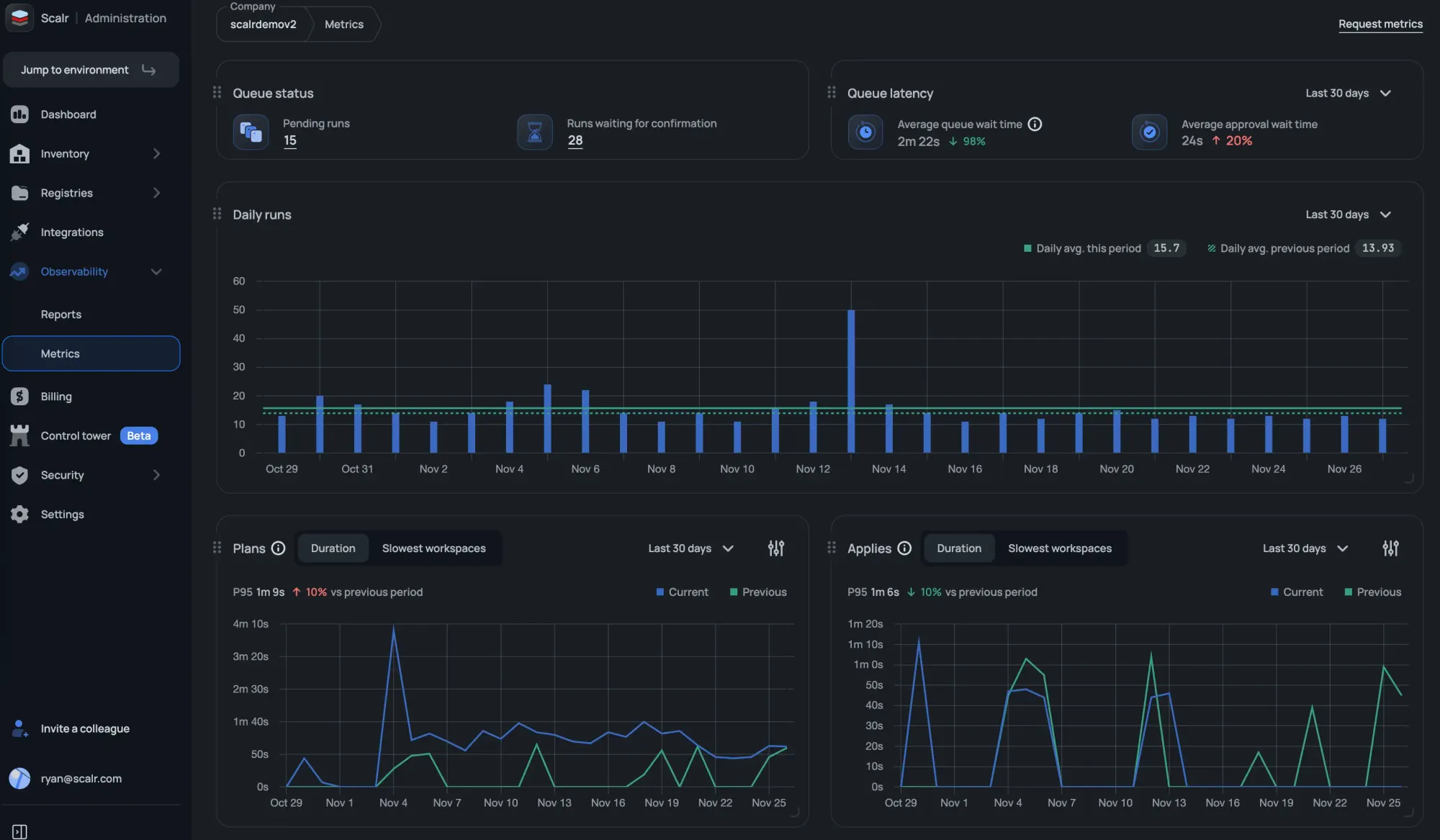
Selecting a Terraform Cloud Alternative (2026 Guide)
- OpenTofu + Atlantis vs a Managed Platform: When Self-Hosting Costs More
- Should You Renew Terraform Cloud? A 2026 Decision Guide
- How to Evaluate IaC Platform Pricing Models
- Terraform Cloud Pricing Revealed
- Terraform Cloud vs Spacelift
- Scalr vs Terraform Cloud Pricing: Per-Run vs Per-Resource (RUM)
- Key similarities of Scalr and Terraform Cloud that make Scalr the alternative
- Terraform Cloud Pricing and Tiers Explained (2026)
- Announcing Public Beta