

Article · part of a guide
OpenTofu + Atlantis vs a Managed Platform: When Self-Hosting Costs More
Going fully self-hosted on OpenTofu and Atlantis looks free next to a Terraform Cloud bill. This 2026 total-cost-of-ownership comparison covers what the open-source stack includes, where it wins, and where it can cost more than a managed platform.

Key takeaways
- Self-hosted OpenTofu + Atlantis has no license fee, but the total cost shows up as engineering time: state storage and locking, server upkeep, secrets, concurrency, policy, RBAC, drift, and on-call.
- Self-hosting wins for teams with strong platform engineering, simple governance needs, and a hard requirement to keep everything in-house.
- Atlantis runs are effectively single-threaded per server, so concurrency becomes a bottleneck as the team grows, the same pain that drives people off Terraform Cloud's run caps.
- A managed platform trades a per-run or per-resource fee for removing that operational burden; the comparison is the fee versus the loaded cost of the engineering time the stack consumes.
- Scalr runs OpenTofu natively and bills per run (free up to 50 runs/month), so teams can keep OpenTofu without owning the maintenance.
When the legacy HCP Terraform free tier reached end of life on March 31, 2026, a lot of teams reached the same conclusion: if we're going to pay, why not drop the SaaS entirely and run OpenTofu with Atlantis ourselves? It's a reasonable instinct, and for some teams it's the right answer. But "free" open-source software still carries a total cost of ownership, and it arrives later as engineering time instead of up front as an invoice. The comparison below lays out both sides so you can choose with eyes open.
What does a self-hosted OpenTofu + Atlantis stack actually include?
OpenTofu gives you the engine and Atlantis gives you pull-request automation. Everything else, you assemble and run:
- State storage and locking. Typically an S3 bucket plus a DynamoDB table, configured and secured by you.
- The Atlantis server. A process you deploy, patch, monitor, and keep available.
- Secrets handling. Cloud credentials and provider tokens, injected safely into runs.
- Concurrency. Atlantis processes runs through a single server, so parallelism is something you design around.
- Policy enforcement. Wiring in OPA or Checkov yourself if you need guardrails.
- RBAC. Atlantis has limited built-in access control, so fine-grained permissions usually live in your VCS and cloud IAM.
- Drift detection, upgrades, and high availability. All owned by your team.
None of this is exotic, and a capable platform engineer can stand it up. The harder part is what it costs to keep running as the team grows.
Where self-hosting genuinely wins
There are real cases where the open-source stack is the better choice:
- No license fee. You pay for compute and storage, not a per-run or per-resource subscription.
- Full control and data residency. State, credentials, and execution stay entirely in your infrastructure.
- Simplicity at small scale. For a single team with a handful of repositories and modest governance needs, Atlantis is straightforward and dependable.
- No vendor dependency. OpenTofu is governed by the Linux Foundation, so there's no commercial lock-in or license-change risk.
If that describes your situation, self-hosting is a sound call.
Where self-hosting costs more than it looks
The total cost of ownership shows up in three places:
- Engineering time. Building, securing, and maintaining the stack is real work, and it competes with everything else your platform team could be doing. The maintenance doesn't stop after setup: upgrades, incidents, and requests keep coming.
- Concurrency bottlenecks. Because Atlantis runs through a single server process, plans and applies queue behind one another as more developers push changes. That's the same run-cap pain that pushes teams off Terraform Cloud's lower tiers, recreated in your own infrastructure.
- Missing governance features. Fine-grained RBAC, policy impact analysis, drift detection, a module registry, and audit logging are either absent or assembled from separate tools. Building and maintaining them adds to the engineering bill.
What matters is the loaded cost of the time the stack consumes. One platform engineer spending a real slice of their week on Atlantis upkeep can cost more than a managed platform's fee, well before you count the opportunity cost of what they could build instead.
OpenTofu + Atlantis vs a managed platform: a cost comparison
| Dimension | Self-hosted OpenTofu + Atlantis | Managed platform (e.g. Scalr) |
|---|---|---|
| Direct fee | None (compute + storage only) | Per run or per resource |
| Setup | You build it | Connect VCS and go |
| State + locking | You run S3 + DynamoDB | Managed (or your own backend) |
| Concurrency | Single-server bottleneck | Scales without a slot to mis-provision |
| RBAC | Limited; via VCS/IAM | Built-in, fine-grained |
| Policy / drift | Assemble OPA, Checkov yourself | Built in |
| Upgrades / HA / on-call | Your team | The vendor |
| OpenTofu support | Native | Native |
| Real cost | Engineering time | The fee vs. the time it replaces |
When should you self-host vs use a managed platform?
Self-host if you have the platform engineering capacity to run it, your governance needs are simple, and keeping everything in-house is a firm requirement. Choose a managed platform when concurrency, RBAC, policy, and drift detection matter and you'd rather not build them, or when the engineering time the stack consumes is worth more than the platform fee. The deciding number is your own. Estimate the hours your team spends (or would spend) running the stack, load them at a fully-burdened rate, and compare against a platform quote.
Can you get OpenTofu without the maintenance burden?
Yes. OpenTofu doesn't require self-hosting everything around it. Scalr is a founding member of the OpenTofu project and runs it natively as a remote operations backend, so your terraform/tofu CLI workflow stays the same while state, concurrency, policy, and RBAC are handled for you. Billing is per run (free up to 50 runs/month, then volume-discounted), and OpenTofu runs are covered (see OpenTofu runs are free in Scalr). You can still keep state in your own S3 or Azure backend if data residency is the reason you considered self-hosting in the first place.
To compare a per-run bill against the cost of running your own stack, or against a Terraform Cloud renewal quote, put your run history through the Scalr pricing calculator. If you're weighing this as part of a broader move, start from the pillar guide on selecting a Terraform Cloud alternative or, if your contract is up, whether to renew Terraform Cloud.
This post is part of our series on Terraform Cloud.
Frequently asked questions
Is OpenTofu with Atlantis really free?
There's no license fee. Both OpenTofu and Atlantis are open source. The cost is operational: you run and maintain the Atlantis server, state storage and locking (for example S3 plus DynamoDB), secrets handling, policy enforcement, and upgrades. For a small, stable setup that cost is low; for a growing team it becomes meaningful engineering time.
What are the limitations of Atlantis at scale?
Atlantis executes runs through a single server process, so concurrency is limited and runs queue as the team grows. Credentials concentrate on that one server, which is a security consideration. It also has limited built-in RBAC, policy, and drift detection compared with a managed platform. Those limits tend to bite as the number of repos, runs, and teams grows.
When should I self-host instead of using a managed platform?
Self-host when you have the platform engineering capacity to run it, your governance needs are simple, and keeping everything in your own infrastructure is a hard requirement. Use a managed platform when the engineering time the stack consumes is worth more than the platform fee, or when you need concurrency, RBAC, policy, and drift detection without building them.
Can I use OpenTofu without self-hosting everything?
Yes. Managed platforms including Scalr, Spacelift, and env0 run OpenTofu natively. Scalr is a founding member of the OpenTofu project, runs it as a remote operations backend, and bills per run (free up to 50 runs/month), so you keep OpenTofu without owning the Atlantis server, state backend, and on-call burden.
What does a managed platform give a platform team that self-hosted Atlantis doesn't?
Mainly fleet visibility. Self-hosted Atlantis runs plans and applies, but the platform team still has to assemble its own view of what is happening across the estate. Scalr aggregates resources across every workspace's state into one dashboard. It adds Modules, Providers, Versions, Drift, and Stale Workspaces reports, plus queued-runs and pending-approvals metrics and event streaming to Datadog. The team can spot a struggling project and step in to raise a quota or unblock a run. Because every workspace shares one Terraform or OpenTofu state schema, those reports read the state objects directly instead of being stitched together by hand. Scalr is also a drop-in Terraform Cloud alternative, so the same dashboard covers the whole estate without each team wiring up its own reporting.
About the author

director of platform engineering at Scalr
Ryan Fee is the director of platform engineering at Scalr, with over 15 years of experience improving infrastructure experiences at companies large and small.
Part of this guide
11 sheets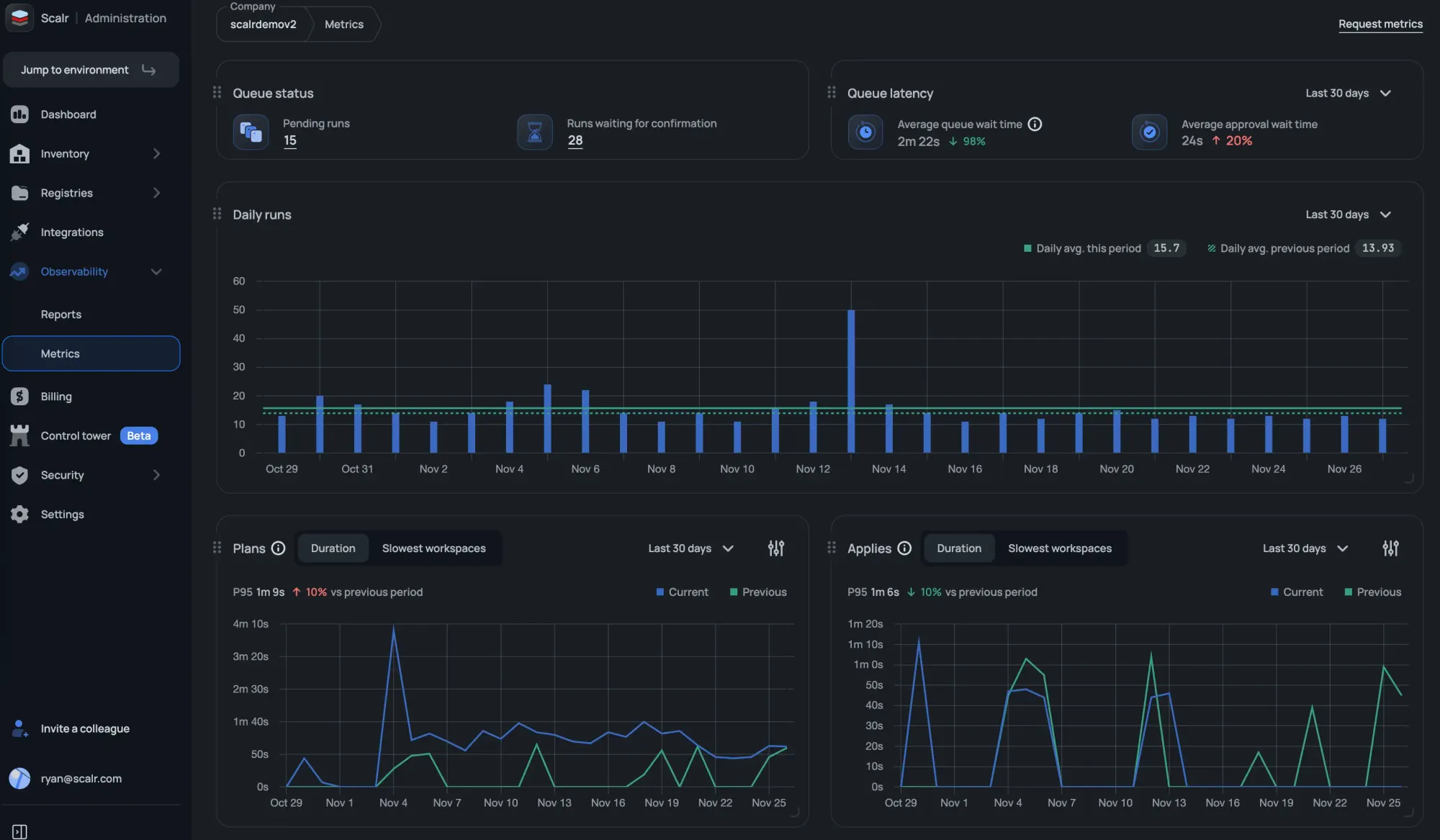
Selecting a Terraform Cloud Alternative (2026 Guide)
- Should You Renew Terraform Cloud? A 2026 Decision Guide
- Spacelift Alternatives: Spacelift vs Scalr, Terraform Cloud, env0, and Atlantis (2026)
- How to Evaluate IaC Platform Pricing Models
- Terraform Cloud Pricing Revealed
- Terraform Cloud vs Spacelift
- Scalr vs Terraform Cloud Pricing: Per-Run vs Per-Resource (RUM)
- Key similarities of Scalr and Terraform Cloud that make Scalr the alternative
- Terraform Cloud Pricing and Tiers Explained (2026)
- Announcing Public Beta