

Article · part of a guide
The Terraform & OpenTofu Terralith
How to avoid the dreaded Terralith

Key takeaways
- A Terralith is a Terraform or OpenTofu configuration where all or most infrastructure is defined in a single large root module, which usually grows from a simple module over time.
- Terraliths cause problems including a massive blast radius, slow plan and apply speeds, merge conflicts, and a poor developer experience.
- The recommended fix is to break a Terralith into purposefully built, reusable modules and workspaces, keeping root modules simple and primarily calling other modules.
- Scalr features like the private module registry, remote state management, workspaces, run triggers, OPA policies, and concurrent runs help teams gradually break down a Terralith.
- These platform features do not solve the fundamental issues of a monolithic architecture, so the ultimate goal remains refactoring into a modular structure.
A Terraform or OpenTofu Terralith is a Terraform configuration where all or most of the infrastructure is defined in a single, large root module. You'll find a huge collection of Terraform resources, input variables, and outputs all sitting in a handful of .tf files in the same directory.
Nobody sets out to build one massive module that does everything. It usually starts as a simple module that grows with minor additions over time. Keeping everything in one place is easy to get going with: a main.tf for your resources, a variables.tf for your input variables, maybe an outputs.tf for any outputs you need. But as your infrastructure and Terraform adoption grow, that single module gets unwieldy and hard to manage.
Why You Should Avoid a Terralith
A few problems show up as a Terralith grows, and there's a better practice for each one.
First off, the blast radius of a Terralith can be massive. You make one minor change to a simple resource, but you now have to think of all of the cascading effects it might have on all other resources within the module.
Instead, you should break it down into multiple purposefully built modules. Terraform modules let you create reusable components that you piece together, so no single change carries a massive blast radius. Without modules, you lose code reuse and abstraction, and you're more likely to end up with duplicate code across your configuration. That violates DRY (Don't Repeat Yourself) principles and makes updates and maintenance more time-consuming and error-prone.
Root modules aren't bad, though, and you should still use them. Your root modules should be relatively simple, primarily calling other modules and passing variables. That keeps your main configuration clean and easy to follow at a high level.
Next, think about the speed of your development cycles. With a Terralith, your Terraform plan and apply speeds will be very long as Terraform will need to check all existing resources against the Terralith. Even one small change requires planning and testing the entire infrastructure. This slows down your development velocity, which breaks the whole idea behind DevOps. Instead, break the deployments down into smaller reusable modules and workspaces that execute quicker and are easier to troubleshoot.
A Terralith also impacts your developer experience as you must closely monitor who has access to the code to make changes. The merge conflicts in your VCS repository would turn into a massive headache if multiple people were making changes to the code base at the same time. Instead, developers prefer a self-service approach where they can pick and choose modules they need to use, create their Terraform configuration files from that, deploy the Terraform resources as they need, and manage the Terraform state.
How Scalr Helps with the Terralith
Scalr won't fix a Terralith on its own, but its features point you toward better habits. For teams that already have one, it gives you a way to start carving it into manageable workspaces while you clean up the code. Here are some of the features that help:
Private Module Registry: As you refactor your Terralith into modules, Scalr's private module registry provides a centralized location to store, version, and share your modules. This helps users take the building blocks to create their own Terraform configuration files.
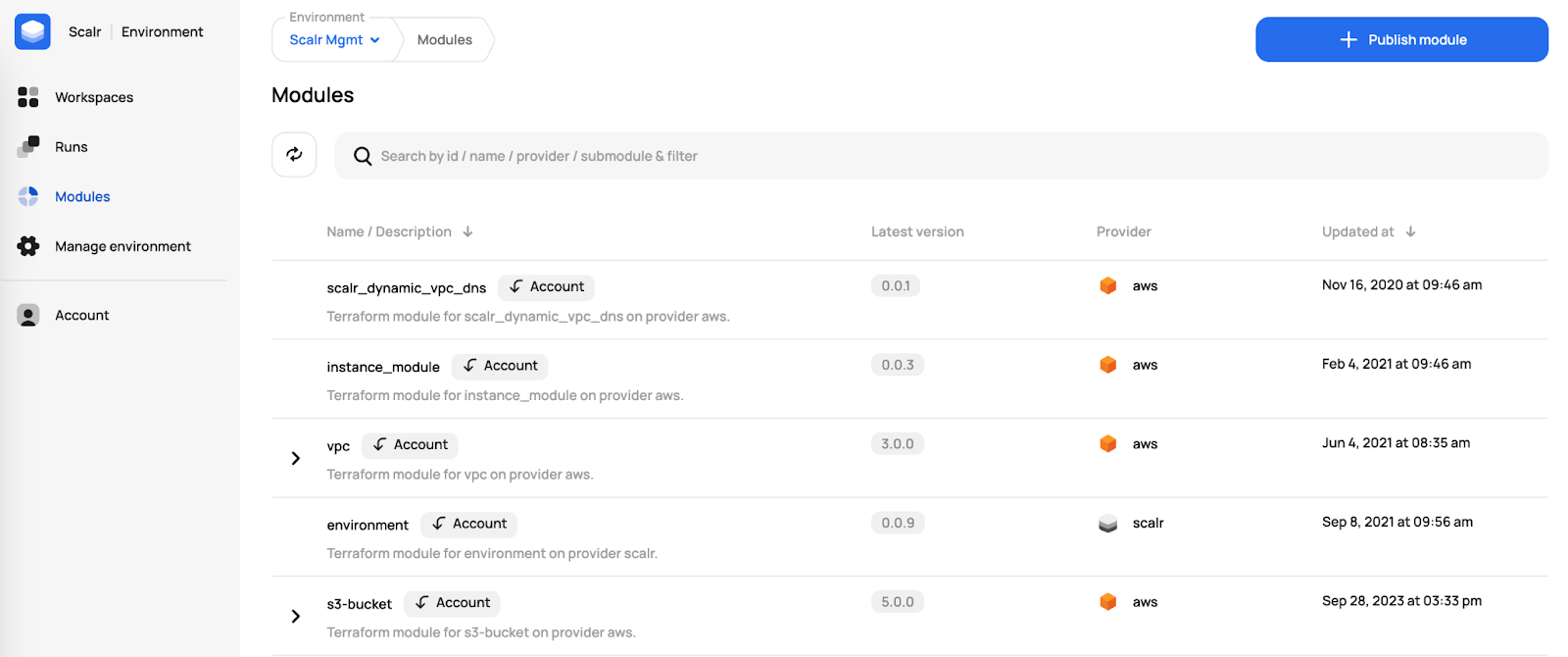
Scalr's Module Directory
Remote State Management: Scalr offers remote state management, which helps even while you still have a Terralith: it prevents state file conflicts and keeps your state in one central location, so collaboration is easier and the risk of state file loss or corruption goes down.
Workspace Management: Scalr's workspace feature lets you manage different Terraform deployments or components separately, even if they're part of a monolithic configuration. This can be a stepping stone towards modularization, as you can start separating the code at the workspace level before refactoring your code. Workspaces also promote self-service as there are access controls around who can create, update the workspaces, and execute a Terraform run from the workspace. A workspace has a one-to-one mapping with a single state file.
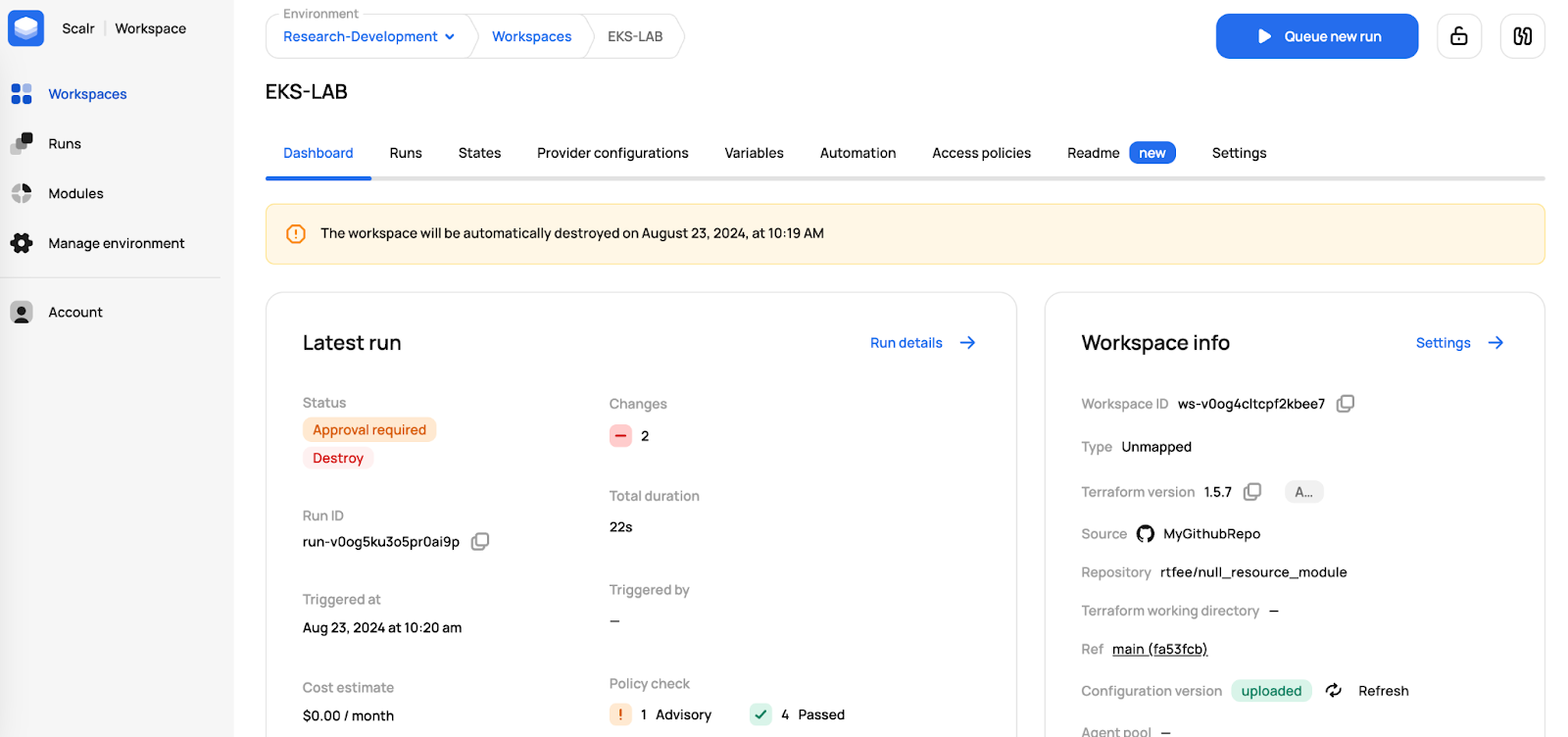
Scalr's Workspace Dashboard
Version Control Integration: By integrating with version control systems (VCS), such as Gitlab or Github, Scalr encourages better code organization and collaboration practices. Workspace owners can define working directories and trigger patterns to help focus on specific areas of code that should trigger a run.
Run Triggers: Run triggers in Scalr can help manage dependencies between different parts of your infrastructure, which can be particularly useful when breaking your Terralith into smaller, interconnected pieces. Run triggers will trigger a run in a downstream workspace based on an upstream workspace having a successful apply.
Policy as Code (OPA): Scalr's integration with OPA can help enforce best practices and prevent further growth of the Terralith by setting rules about resource creation, naming conventions, and other aspects of your Terraform configuration. OPA policies can define which modules can be used for specific Terraform resources.
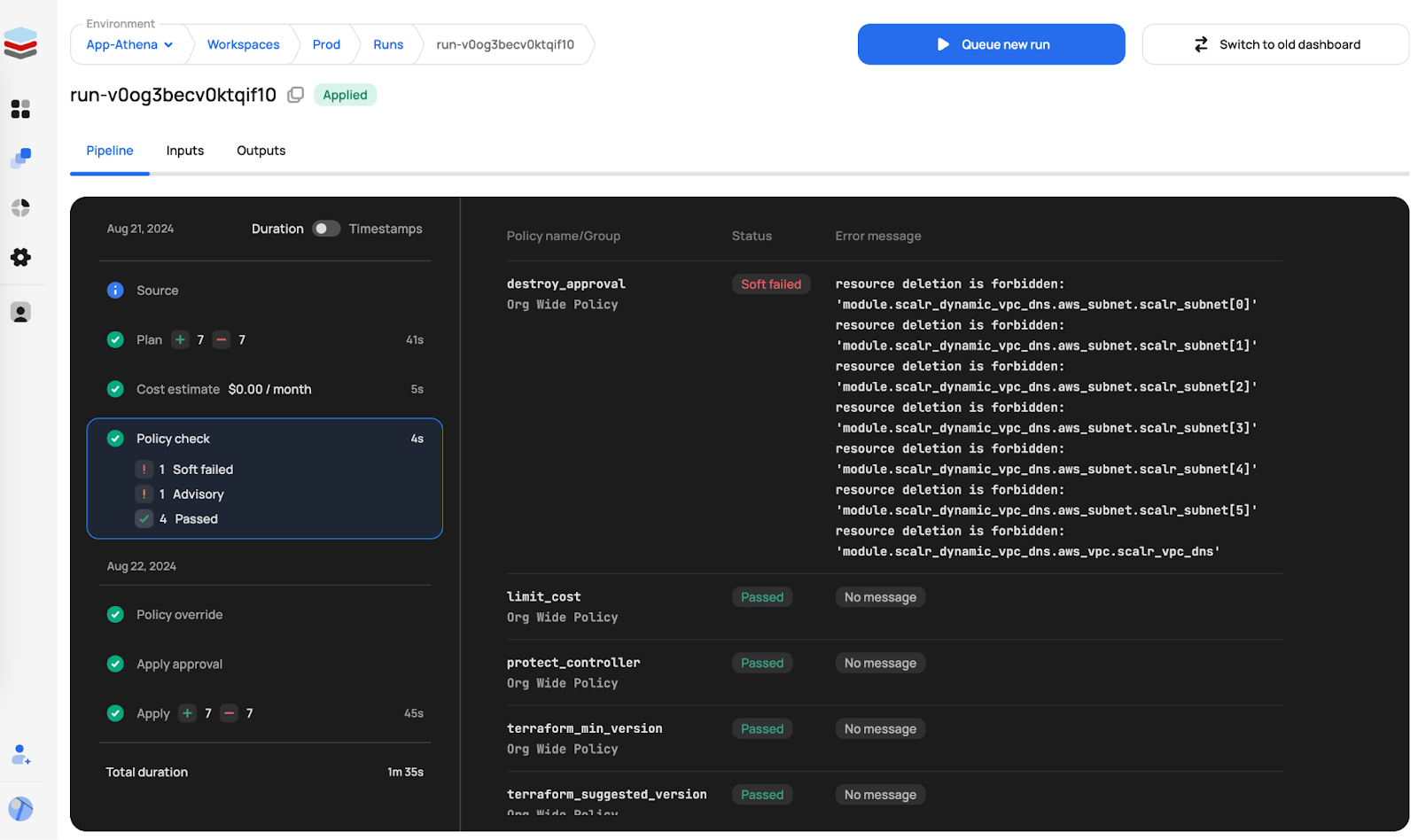
Scalr's Run Pipeline Dashboard
Concurrent Runs: Scalr allows for concurrent runs, which can help mitigate some of the performance issues associated with large, monolithic configurations. After breaking down the Terralith, you might go from a single run to ten runs, but you don't want them to run in a serial pattern. Scalr can support concurrent runs, helping you speed up your development cycles. Unlike concurrency-based pricing models (used by some alternatives), where you pay for a fixed number of parallel run slots whether or not you use them, Scalr's usage-based pricing charges only for runs that actually executed, so splitting a Terralith into many smaller workspaces doesn't punish you with a higher slot bill.
Variable Management: Centralized variable management in Scalr can help organize and control the numerous variables that often come with a Terralith, making it easier to refactor and modularize over time. These variables can be passed down to the modules that are consumed within the workspaces.
Team Management and Permissions: As you begin to break down your Terralith, Scalr's team management features allow you to control access to different parts of your infrastructure, encouraging separation of duty. This is the key to promoting self-service and improving your developer experience.
These features help you manage a Terralith, but they don't solve the fundamental issues of a monolithic architecture. The goal is still to refactor the Terralith into a more modular, maintainable structure. Scalr just makes that easier by giving you a platform for collaboration, state management, and refactoring a piece at a time.
Summary
A set of small, reusable Terraform modules sets your organization up better for the long term. Starting with one module and piling resources onto it feels easy, but the problem compounds and catches up with you later. Put the good practices in place early, and consider a product like Scalr or HashiCorp Terraform Cloud to guide you toward something that scales.
Sign up for Scalr to try these features on your own configuration.
About the author

director of platform engineering at Scalr
Ryan Fee is the director of platform engineering at Scalr, with over 15 years of experience improving infrastructure experiences at companies large and small.
Part of this guide
15 sheets
What is OpenTofu?
- What Is an OpenTofu Management Platform?
- An Overview of Scalr's CI/CD Capabilities for Terraform and OpenTofu
- Debugging opentofu apply Failures
- Scalr VSCode Extension for Terraform & OpenTofu
- New Feature: Terraform & OpenTofu Ephemeral Workspaces
- Understanding Terraform & OpenTofu Workspaces
- OpenTofu Language Guide
- API Driven Workflows for Terraform and OpenTofu
- OpenTofu Runs are Free in Scalr
- 10 OpenTofu Commands
- Finding a Home for OpenTofu: Unpacking The Decision to Join The Linux Foundation
- Announcing OpenTF
- Is Terraform Still Open Source?